

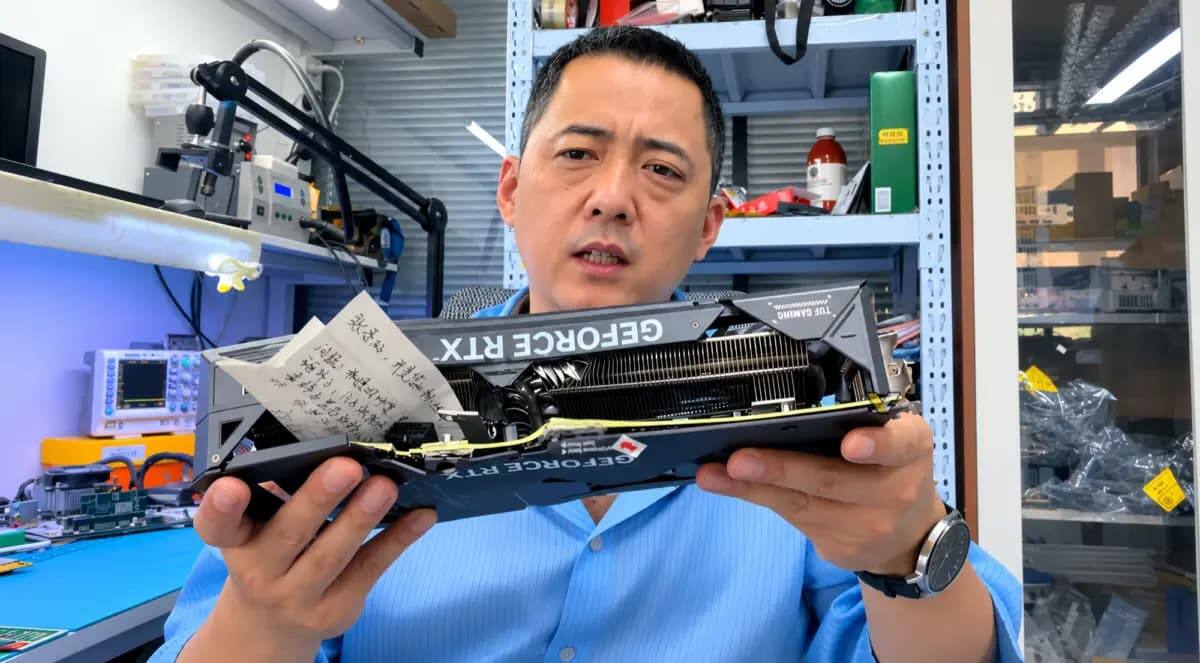
A battered ASUS TUF GeForce RTX 4070 SUPER has been brought back to life after an unusually violent kind of failure: it was hit with a hammer during a domestic dispute, then revived by moving its GPU and memory onto a donor board. The repair was done by Brother Zhang, a Chinese electronics specialist on YouTube, and it worked well enough for the card to boot and pass stress tests.
The interesting part is what survived. The damage was severe on the outside – a bent metal heat spreader, shifted display outputs, a cracked and delaminating PCB, and broken traces – but diagnostics pointed to the destroyed board rather than the graphics processor or memory as the main problem. In repair terms, that is the difference between a brutal write-off and a very expensive puzzle.
What the hammer left behind
According to the repairer, the system had already been powered off when the damage happened. That detail mattered: if the board had been smashed while running, the odds of a dead GPU or memory chip would have been much worse. A short circuit showed up on the 1.8 V line, but the source of the fault was the ruined board itself.
That kind of diagnosis is what separates a real repair from a hopeful parts swap. Modern graphics cards are dense, layered, and unforgiving, so once the PCB is split or traces are torn, the original board is usually finished. China’s busy repair scene has turned board transplants into a practical survival tactic for high-end hardware, and this card is a textbook example.
RTX 4070 SUPER GPU and memory moved to a donor board
With the original PCB beyond saving, Brother Zhang removed the GPU and memory chips from the damaged RTX 4070 SUPER and reinstalled them onto a fully working replacement board. After reassembly, the card started normally and completed stress testing, which is about as close to a happy ending as a hammer story gets.
- Card: ASUS TUF GeForce RTX 4070 SUPER
- Damage: hammer strikes, bent heat spreader, displaced video outputs, cracked PCB, broken traces
- Repair method: GPU and memory transplanted to a donor PCB
- Result: the card powered on and passed stress tests
Why this repair was possible
This story is less about brute-force resilience than about timing. Because the damage happened after shutdown, the sensitive silicon appears to have escaped the worst of it, which gave the repair a fighting chance. If there is a lesson here, it is that a dead board and a dead GPU are not the same thing – and in the right hands, that distinction can save a very expensive graphics card.
The obvious question is whether this kind of resurrection makes economic sense outside a showcase repair shop. Usually it does only when the chip package survives and a donor board is available, which is why these dramatic fixes are still rare. The next test for cards like this will not be the hammer; it will be whether board-level repair keeps scaling as GPUs get more complex and more tightly integrated.