

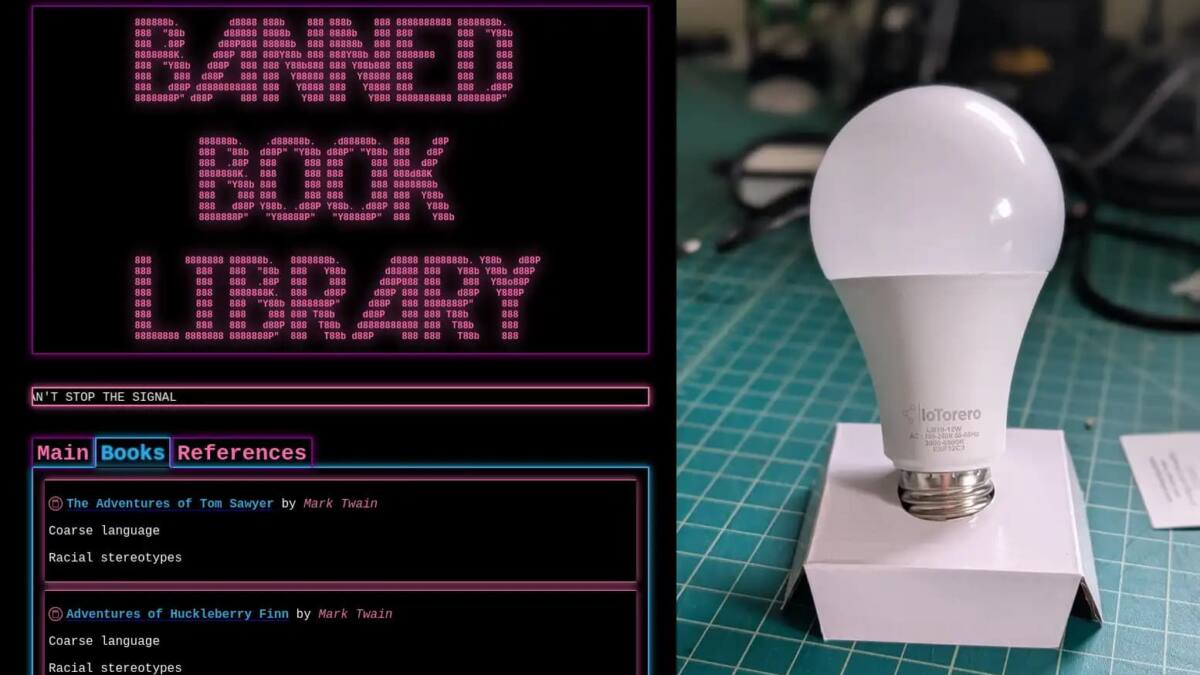
A security researcher has turned a cheap smart bulb into an offline Wi‑Fi book library that shares ebooks without touching the internet. The result is part gadget, part hidden stash, and exactly the sort of unnecessary engineering that makes the best kind of internet hardware hack.
Richard Osgood built the system around an ESP32C3-based bulb running Tasmota firmware, then added its own web server and access point mode. Instead of chasing cloud features, he pushed the device toward self-contained storage and local-only access, which is a neat rebuke to the usual ”smart” home model where everything dies the moment a service does.
How the offline Wi‑Fi book library works
The project is small on paper and even smaller in memory. The lamp has 4 MB of storage, and after software trimming, about 2 MB is available for books. That is not much by modern gadget standards, but it still leaves room for dozens or even hundreds of plain text works without images.
- ESP32C3 smart bulb hardware
- Tasmota-based firmware
- Built-in web server
- Open Wi‑Fi network
- Browser-based reading interface
Getting in is deliberately simple: connect to the bulb’s Wi‑Fi network, open a page in a browser, and start reading. No account, no cloud login, no registration hoops. For a device this small, that simplicity is the whole trick.
Why the microSD plan was dropped
Osgood initially wanted to add microSD storage, which would have made the project much less cramped. Hardware limits got in the way, so the library had to live entirely in the bulb’s internal memory instead. That constraint actually sharpens the concept: the whole point is not capacity, but concealment and independence.
For the demo, he loaded public-domain works, though the system can handle any text files that fit. OTA updates are supported too, so the firmware can be refreshed wirelessly without cracking open the hardware. In a field full of cloud-first products, a lamp that stores its own books and talks only to nearby devices feels weirdly sensible.
A tiny device with old-school appeal
The broader pattern here is familiar: hobbyists keep finding ways to strip consumer hardware of its intended role and make it more useful offline. Smart home gear is often sold as convenience, but the most interesting projects usually come from refusing the cloud entirely. Expect more of that as people get tired of renting access to devices they already own.