

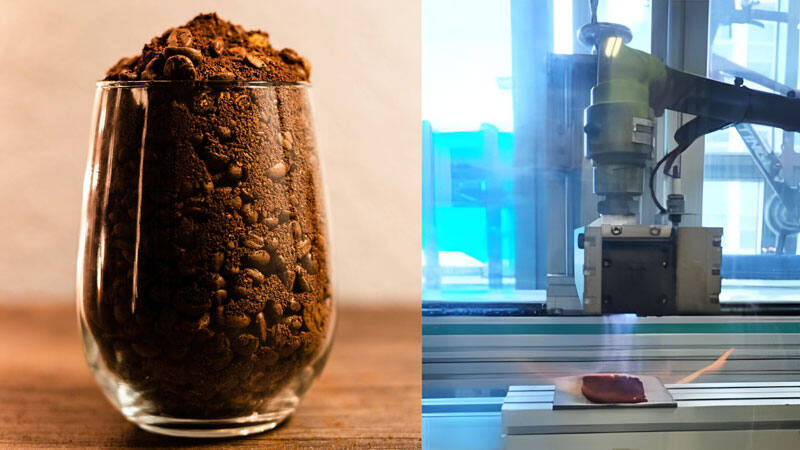
A South Korean research team says it has found a way to turn wet spent coffee grounds into high-energy biochar in just 90 seconds, skipping the drying step that has long made coffee waste awkward and expensive to process. The pitch is simple: keep the waste wet, hit it with an intense plasma flame, and let the water help do the work instead of sabotaging it.
The method could give coffee waste a faster, on-site route to cleaner fuel feedstock instead of paying to haul around a soggy liability. If the process scales outside the lab, it could be useful for cafés, roasters, and food-service sites where coffee grounds are generated and collected most easily.
How the flame plasma pyrolysis process works
The technique, developed at the Korea Institute of Geoscience and Mineral Resources, is called flame plasma pyrolysis. Unlike conventional biomass processing, it can handle feedstock with about 55% moisture without any pre-drying or defatting. Wet coffee grounds are fed directly into a plasma flame zone at atmospheric pressure.
The system runs on liquefied petroleum gas – a propane-butane mix – plus compressed air, producing a flame at 800-900 °C. At that temperature, water inside the particles flashes into steam, pressure builds, and the grains burst in tiny ”popcorn” micro-explosions. In one move, the process dries, carbonizes, and opens up the material’s pore structure.
Biochar performance beats raw coffee grounds
Under optimal conditions, the starting mass fell by 83.3%, while the fuel value of the resulting biochar reached 29.0 MJ/kg, up from 21.8 MJ/kg in the original coffee grounds. That puts it in anthracite territory, at least on paper, and makes this much more than a waste-disposal trick.
- Fixed carbon rose from 15.6% to 46.2%
- Specific surface area increased from 1.5 to 115.4 m²/g
- Sulfur compounds were removed almost completely
- Smoke and tar-like byproducts stayed minimal
That sulfur removal is especially useful, because less sulfur means fewer sulfur oxide emissions when the fuel is burned. The low-smoke output also helps, since anyone who has watched biomass systems choke on tar knows that ”clean burning” is usually a sales phrase before it is a reality.
Why speed could matter more than chemistry
The biggest advantage here may be timing, not just chemistry. Hydrothermal carbonization typically takes one to six hours, and torrefaction takes tens of minutes, while this method finishes in 90 seconds. That kind of throughput changes the economics of small, distributed waste processing, especially if the equipment can sit near the source.
The researchers say the approach should not be limited to coffee grounds. They point to other wet organic wastes such as food scraps, sewage sludge, and agricultural biomass, all of which share the same annoying trait: they are heavy, waterlogged, and expensive to handle. More than 10 million tons of coffee grounds are generated globally each year, so the feedstock is hardly niche.
What has to happen before factories care
The concept is promising, but industrial adoption still needs better equipment design and process optimization. That is the usual gap between a clever lab result and a machine that can survive real-world operations, where maintenance bills and consistency have a nasty habit of killing elegant ideas.
If the South Korean team can push the system beyond the pilot stage, the likely winners are waste handlers and biomass processors looking for faster, cleaner conversion. The bigger question is whether the economics still work once the flame-plasma hardware leaves the paper and enters the plant floor.