

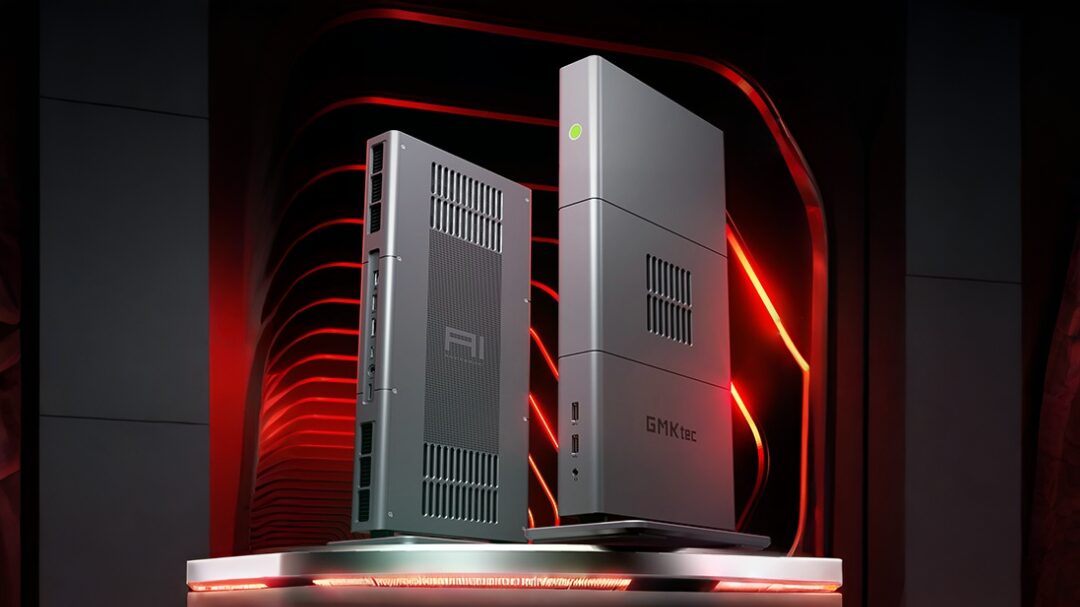
GMKtec is lining up the Evo-X3 for a June 29 global launch, and the pitch is simple: take the Evo-X2 formula, add a faster AMD Ryzen AI Max+ 395 APU, OCuLink expansion, and enough memory headroom to make local AI workloads feel less like a stunt. The result is a compact mini PC that wants to be a workstation first and a tiny desktop second.
The GMKtec Evo-X3 also leans hard into the growing mini PC with OCuLink and Ryzen AI Max+ 395 mini PC search territory. Mini PC makers are clearly chasing a more demanding buyer now, not just people who want a small box under the monitor. OCuLink has become the shortcut to credibility because it gives these systems a practical upgrade path for external GPUs, while high-capacity LPDDR5X helps them talk seriously about on-device AI instead of just wallpapering the chassis with buzzwords.
Ryzen AI Max+ 395 inside a PS4-sized chassis
Inside the PS4-sized case, the Evo-X3 uses AMD’s Ryzen AI Max+ 395, a 16-core, 32-thread chip built on Zen 5. It pairs that with integrated Radeon 8060S graphics based on RDNA 3.5, plus up to 128GB of 8000MHz LPDDR5X memory and up to 4TB of storage across dual PCIe 4.0 M.2 slots.
- CPU: AMD Ryzen AI Max+ 395
- Cores and threads: 16 cores, 32 threads
- Graphics: Radeon 8060S, RDNA 3.5
- Memory: up to 128GB 8000MHz LPDDR5X
- Storage: up to 4TB via dual PCIe 4.0 M.2 slots
OCuLink gives the Evo-X3 its upgrade story
The biggest hardware change over the previous model is the OCuLink port, which runs at PCIe Gen4 x4. GMKtec is using that to promise a cleaner upgrade path for an external RTX 40- or 50-series GPU, which is the kind of practical flexibility buyers actually remember after the spec sheet fades.
That matters because integrated graphics are fine until they aren’t. For 3D rendering, heavier creative work, or compute tasks that outgrow the APU, being able to plug in real muscle is a lot more honest than pretending a tiny box can do everything forever.
Claw+Wrangler and a 140W cooling setup
GMKtec is also bundling the system with its Claw+Wrangler AI software ecosystem, and it is leaning hard into the idea of a local AI workstation. The company says the 128GB configuration is meant to run large language models such as the 235-billion-parameter Qwen3 entirely offline.
To keep the 140W APU under control, the Evo-X3 uses a triple heat-pipe cooling system with dual fans. Connectivity includes Wi-Fi 7, Bluetooth 5.4, and a 2.5GbE LAN port, while the graphite gray chassis is shaped for vertical placement and a small desk footprint rather than flashy gaming-room theatrics.
Launch timing and likely pricing
Early access registration opens on June 22 and includes a $20 discount, ahead of the full launch on June 29. GMKtec has not announced pricing yet, but the Evo-X2 currently sells for around $2,000, so the Evo-X3 is likely headed for similar premium territory. That would put it in the same conversation as a growing wave of OCuLink-equipped compact systems from rivals such as Peladn and Minisforum, which have been pushing harder on AI performance and external GPU support.
If GMKtec gets the thermals and noise profile right, the Evo-X3 could be one of the first mini PCs that feels genuinely built for local AI work rather than simply decorated for it. The real test is whether buyers will pay workstation money for a box this small, or wait for the next round of more aggressively priced competitors to undercut the concept.