

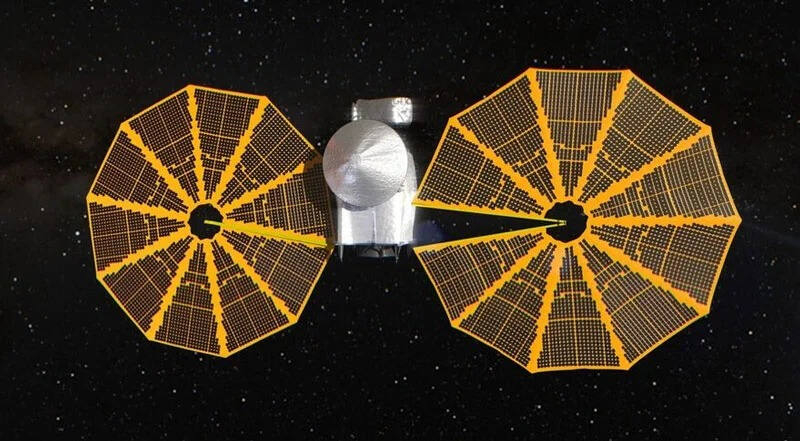
NASA’s Lucy spacecraft has turned a brief flyby of the asteroid Donaldjohanson into a surprisingly rich science stop: the object is a tumbling, peanut-shaped fragment with evidence that water once altered its surface. The flyby happened in April 2025 as Lucy continues toward Jupiter’s Trojan asteroids, and it gave mission teams a useful dress rehearsal before the main event arrives on 12 August 2027.
Donaldjohanson is not one of Lucy’s headline targets, but it may end up being one of the mission’s most instructive. The asteroid belongs to the Erigone family, a group formed after a larger body broke apart about 155 million years ago, which makes it a relatively young object by asteroid standards and a useful test case for how fragments evolve after a violent collision.
Lucy’s Donaldjohanson flyby reveals a peanut-shaped asteroid
Lucy passed about 1,000 km from the asteroid at roughly 48,000 km/h, close enough for the L’LORRI camera to reveal a weirdly elegant shape: two larger lobes connected by a narrow waist. That kind of ”dumbbell” form usually points to a gentle merger of two pieces of a parent asteroid, not a head-on smash that pulverized everything into dust. Space rocks, apparently, can have a social life.
The surface is not smooth either. Researchers identified craters, ridges, and flatter areas that may have formed through seismic shaking or later impacts, which is exactly the sort of messy geology you would expect from a body that has spent eons getting battered around the Solar System.
Lucy caught Donaldjohanson tumbling through space
Ground-based observations had already hinted that Donaldjohanson was elongated because its brightness changed on a roughly 10.5-day cycle. Lucy’s data showed something more awkward: the asteroid is in non-principal axis rotation, meaning it is not spinning around a single stable axis but effectively somersaulting through space.
One complete flip takes about 10.5 days, while an extra wobble around its long axis takes about 26.5 days. Scientists think the body may once have rotated at least ten times faster, before the YORP effect slowly changed its spin over 20 to 60 million years. That weak thermal torque sounds tiny, but over geologic time it can rewrite an asteroid’s behavior with all the patience of a cosmic metronome.
Ancient water clues in Lucy’s Donaldjohanson data
The most interesting chemistry came from Lucy’s infrared spectrometer, which found iron-rich clay minerals, or phyllosilicates, that form in the presence of liquid water. The catch is that the water interaction appears to have been brief. If it had gone on longer, the iron in those minerals would have been replaced by more magnesium, more like what is seen on Bennu and Ryugu.
- Asteroid: Donaldjohanson
- Flyby distance: about 1,000 km
- Flyby speed: about 48,000 km/h
- Rotation: non-principal axis, with a 10.5-day flip and a 26.5-day wobble
- Water clue: iron-bearing phyllosilicates
That puts Donaldjohanson in a useful middle category: younger than the best-known carbon-rich asteroids, altered by water but not soaked in it, and shaped by a history of breakup, reassembly, and slow rotational drift. Compare it with Bennu, Ryugu, and Lucy’s future Trojan targets, and you get a better map of how material moved around the early Solar System – including the still-unfinished story of how water reached Earth in the first place.
The next question is whether Lucy’s Trojan encounters will look this tidy. If Donaldjohanson is the warm-up act, the 2027 meeting with Eurybates should tell us whether this mission has been collecting curiosities or building a coherent picture of the Solar System’s oldest leftovers.