

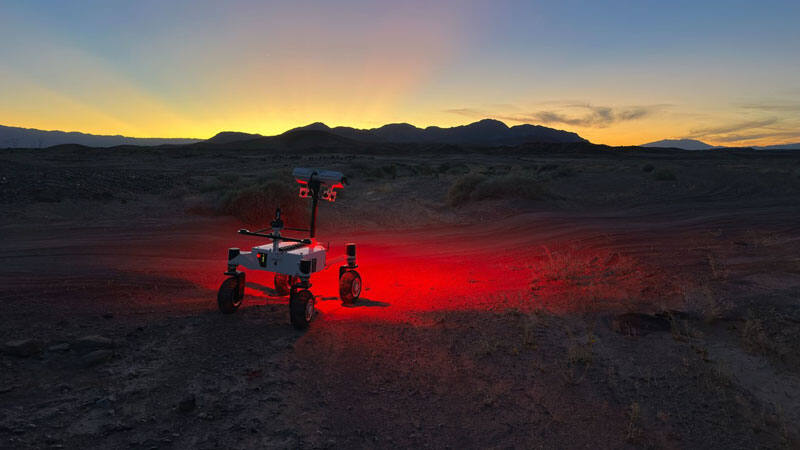
NASA has put an experimental rover through its paces in the Colorado desert, and the little machine has a strange party trick: it can switch between rolling, ”walking” over obstacles, and moving sideways like a crab. Built at JPL, ERNEST is not headed to the Moon or Mars tomorrow, but it is designed to feed future rover designs that can cover far more ground without constant human babysitting.
The payoff is speed and flexibility. During seven days of field tests in March, ERNEST covered about 26 km in 37 hours of driving with minimal engineer intervention, reaching up to 1 km/h on some stretches. That is roughly an order of magnitude faster than the autonomous driving speed of NASA’s Curiosity and Perseverance, and on rough terrain that kind of gain could mean more science per day instead of more time spent staring at rocks from a safe distance.
ERNEST’s active suspension changes the rules
ERNEST stands for Exploration Rover for Navigating Extreme Sloped Terrain, and the name is doing a lot of heavy lifting here. The rover is about 1.2 m long and uses an active suspension system, unlike the passive six-wheel layouts NASA has used since Sojourner. Instead of simply soaking up bumps, the chassis can shift weight, change motion modes, and help the rover tackle slopes and obstacles with more intent than a conventional rover can manage.
- Normal wheel driving for efficient movement
- ”Snake” mode for tricky terrain
- ”Walking” with its wheels to climb obstacles
- Sideways ”crab” movement for tighter positioning
The system can also switch back to a more energy-efficient passive mode when the terrain allows it, which is exactly the sort of practical compromise rover engineers like. Four individually controlled mesh wheels handle forward, reverse, and sideways travel, giving the platform more options than the standard ”point it and hope” strategy that rough ground sometimes demands.
Day, dusk and darkness all mattered
The tests were run at different times of day, including dawn, dusk, and night, because future lunar missions will have to work under ugly lighting. That matters especially in the Moon’s polar regions, where the Sun stays low and throws long shadows that can hide rocks, ledges, and drop-offs from onboard vision systems. NASA is effectively training the rover for a world where the terrain is bad and the lighting is worse.
Autonomy for ERNEST was built with reinforcement learning. Engineers created a high-fidelity virtual model, fed it data from the real rover on different soils, and ran simulations on a compute cluster, sometimes burning through thousands of hours of virtual testing in a single day. The algorithms were then checked in NASA’s Mars Yard, a sandbox full of sand ridges, rock piles, steps, and steep slopes.
The next step is route planning
The open problem is less about whether a rover can move in weird ways and more about when it should. NASA’s next goal is to combine suspension-mode selection with long-range route planning so future machines can decide which obstacles are worth attacking and which are smarter to bypass. That is where the real race sits: not just surviving harsh terrain, but choosing the fastest path through it without making a spectacularly expensive mistake.