

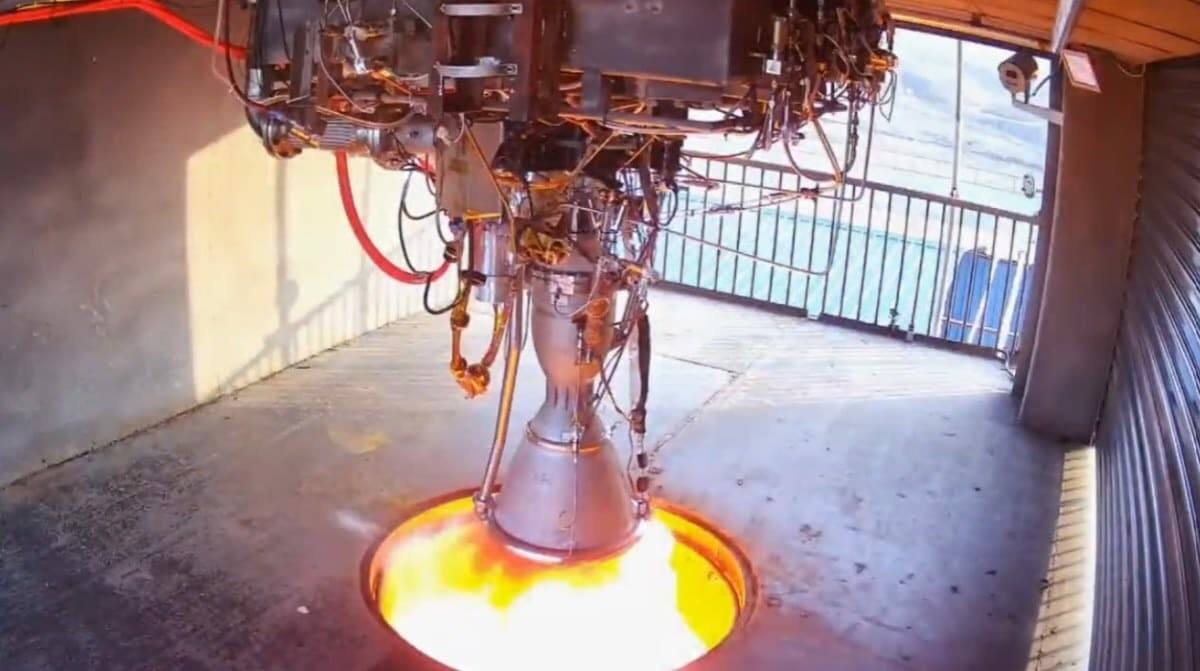
A Chinese startup wants to do something Rocket Lab has only managed with a much smaller vehicle: build a large rocket powered by electric pumps, then fly it in 2027. Spark Space says its Jinhua-1, also known as Evolution-1, is shaping up to be the world’s biggest rocket to use that architecture, and it has just followed successful engine tests with a fresh funding round.
The pitch is straightforward. Electric-pump engines are simpler and lighter because they skip the usual turbopumps and gas generators, but they also bring trade-offs, including battery mass and lower efficiency. That tension is exactly why Rocket Lab moved Neutron to a different cycle, even as Electron remains the best-known proof that the approach can work at small scale.
Lieyan-2 hot-fire test clears first milestone
Spark Space says the Lieyan-2 engine, which burns kerosene and liquid oxygen, has completed its first successful hot-fire tests. The company says the runs validated the design, ignition stability, and behavior under vibration and pressure changes during operation, although it did not disclose how long the tests lasted.
Next up are reliability checks, tests of the first-stage propulsion package, and then full vehicle assembly. That sequence sounds ordinary; the hard part is making a compact, battery-heavy engine system behave like a launch vehicle engine instead of an ambitious lab demo.
Jinhua-1 specs and payload targets
Jinhua-1 is planned as a two-stage expendable rocket measuring 27.5 meters long and 2.25 meters in diameter. The first stage will carry nine Lieyan-2 engines, while the second stage gets one vacuum-optimized engine. Combined liftoff thrust is said to be 90 tons.
- Low Earth orbit payload: up to 1.5 tons
- Sun-synchronous orbit payload: up to 1 ton
- Per-engine thrust: 10 tons
- Electron comparison: about 300 kilograms to low orbit
If those numbers hold, Spark Space is not just chasing a niche. It is aiming for a vehicle that could sit in a far more useful class for satellite deployment than Electron, especially for constellation replenishment where operators want more mass per launch without jumping to a much larger rocket.
Funding, facilities and the race to orbit
The money is arriving fast. Spark Space says it raised nearly 100 million yuan in a Pre-A round in early June, then announced additional funding on June 18 worth tens of millions of yuan. The startup also says it has already attracted seed investment from private funds and entities linked to the city of Hefei.
Work is being done at a facility in Hefei’s national high-tech zone that already spans more than 10,000 square meters, with another 20,000 square meters being added. The company says engineers from CASC, CASIC, and the Chinese Academy of Sciences are on the team, which helps explain why this is not being treated as a garage project with a patriotic logo.
Chinese launch competition is getting crowded
Spark Space wants Jinhua-1 to be a low-cost, quick-turnaround launcher for satellite groupings, and it wants orbit in 2027. That timetable puts it into one of the busiest corners of China’s commercial space sector, where Ceres-1 from Galactic Energy, Kinetica-1 from CAS Space and Kuaizhou-1A from Expace are already flying regularly.
The bigger question is not whether China can build another launcher. It is whether Spark Space can turn a technically clever engine choice into a reliable, competitive business before rivals make the field even more crowded. If it does, the company could become one more useful option in a segment that is moving from novelty to industrial churn.