

Epic Games has set out a clear pitch for Unreal Engine 6: more AI, less drudgery, and more control left in human hands. The company says the next version of its engine will lean on generative models to help studios speed up content creation, while shifting repetitive work away from developers and toward software that can draft, arrange, and automate without taking the wheel.
That sounds like a slick demo, but it is also a telling bet about where game development is heading. As engines get more complex and live-service production keeps chewing up time, the real competition is no longer just about prettier rendering – it is about who can ship iterations faster without turning teams into content factories.
Unreal Engine 6 AI workflow pillars
Epic says UE6 will be built around three main ideas: the Verse programming model for gameplay, portability and compatibility for content and code across games, and deeper integration with AI models. In Epic’s framing, those models should act as ”multipliers of creativity and productivity,” letting teams spend more time on creative and technical work instead of repetitive manual tasks.
The company also says UE6 is designed to ”evolve” how developers release and operate games. That is a polite way of saying the old engine workflow – build, tweak, repeat, then do it again with a larger team – is getting replaced by something more automated and more unified across projects.
What Epic showed at State of Unreal
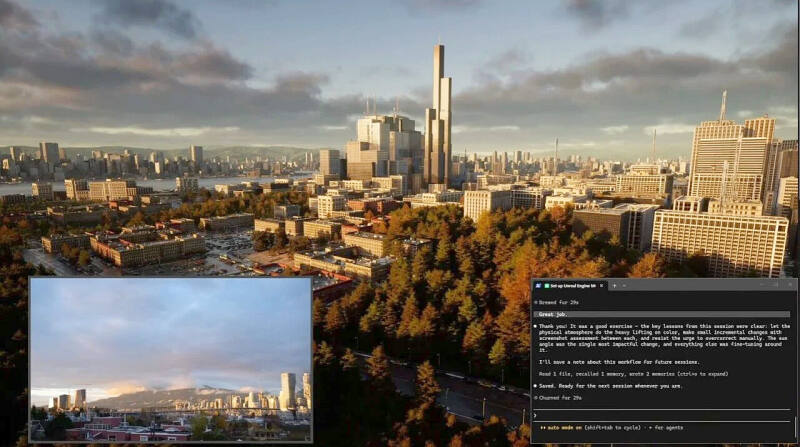
At State of Unreal in Chicago, Epic demonstrated how large language models could work directly with the engine to generate content. In one example, a Claude prompt was used to furnish a virtual apartment by asking for objects that were then pulled from an asset library. In another, an urban scene’s lighting was changed by telling the AI to shift the time of day or by using a still photo as a reference.
Epic was careful to stress that this is not a black box. Developers will still be able to manually adjust the results, which is the part that matters if you do not want your game world to look like it was assembled by a very enthusiastic intern with a prompt box. The company also pointed to AI-assisted level setup, character rigging, particle systems, bone-weight skinning, and lighting as places where the engine could remove repetitive work.
UE6 folds Fortnite and Unreal Engine 5 together
Another big shift is organizational as much as technical. Epic says that over the next two years, UE6 will bring together two core development tracks into a single product: Unreal Engine 5 and Unreal Editor for Fortnite. That merger suggests Epic wants one pipeline that can serve both blockbuster games and creator-driven experiences without making studios juggle separate tool sets.
Epic says rendering will continue to improve, processing time should drop, iteration loops will get more efficient, and mobile apps will become more capable. The company has not given a full technical spec sheet yet, but the direction is obvious: fewer bottlenecks, more reuse, and a stronger push toward production systems that can scale across projects. That is also where the industry is heading, whether studios like it or not; rivals have been racing to bake AI into content tools, but Epic is trying to make it part of the engine itself.
Unreal Engine 6 early access timing
Epic plans to release Unreal Engine 6 in early access by the end of 2027. If it lands on that schedule, the big question will not be whether AI can generate a chair or tweak a skybox – it will be whether teams trust it enough to become part of the standard production pipeline.