

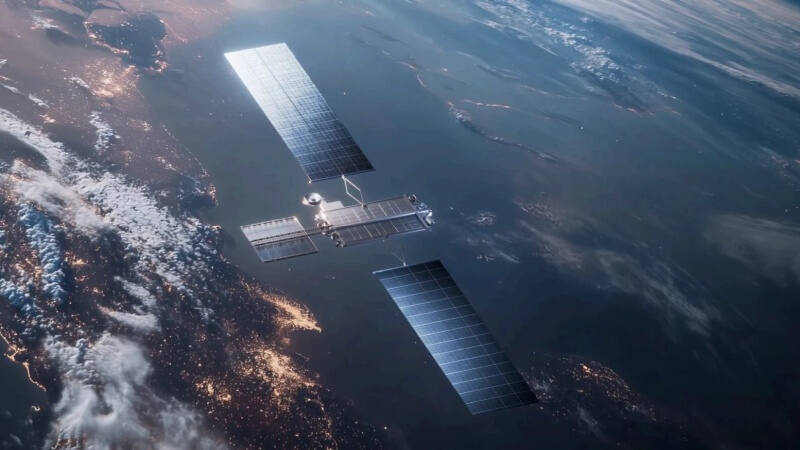
Putting data centers in orbit sounds clever right up until the bill arrives. A new Wood Mackenzie report says a hypothetical 1 GW space-based data center would cost about $170 billion, more than three times the price of a similar facility on Earth, even as rising AI demand pushes companies to look beyond power grids, water supplies, and construction bottlenecks at home.
The pitch is straightforward: future AI agents may need 10,000-40,000 times more compute per task than today’s chatbots, and that kind of load is starting to strain the physical limits of terrestrial infrastructure. In the meantime, the market is still overwhelmingly ground-bound, with 78% of data centers under construction or planned in the US and China.
AI demand is outrunning power and construction capacity
Wood Mackenzie estimates global electricity demand for data centers will reach 460 TWh in 2026, about half of Japan’s total power output. By 2030, that rises to 1,280 TWh, and by 2040, it hits 3,700 TWh, a 703% increase from today at an annual growth rate of 16%. For a sector that already fights for grid access, that is not a rounding error.
The problem is not just electricity. In the US, getting connected to the grid can take as long as seven years, gas turbine deliveries are being pushed out to 2030, cooling systems compete for scarce water, and labor and materials are getting more expensive. That is the sort of squeeze that makes orbital infrastructure look less like science fiction and more like a very expensive pressure valve.
Launch costs still decide the business case
The catch is brutal: launch and platform costs make up roughly 60% of the $170 billion price tag for that 1 GW orbital facility. Wood Mackenzie says space-based data centers would need a 70% cost cut to match land-based alternatives, and that only becomes plausible if the long-running trend of falling launch prices continues.
That trend is real. In 2025, global orbital launch attempts reached 324, up 25% from 2024, and 70% were made by commercial operators. Launch costs have fallen by about 90% thanks to reusable rockets compared with expendable predecessors, which is exactly why the space-data-center idea has moved from novelty to spreadsheet exercise.
SpaceX, xAI and the race for orbital compute
The sector is also highly concentrated. In 2025, 4,517 satellites reached orbit, up 58% from the previous year, and 87% of them belonged to private companies. SpaceX and xAI have announced plans to send 100 GW of computing capacity to orbit each year, which Wood Mackenzie says is ten times the total announced by all other orbital data-center developers combined.
Non-US companies account for less than 0.5 GW of planned orbital capacity, so this is still mostly an American race with a very expensive ticket. The five leading companies are also expected to keep increasing launch activity between 2027 and 2028, which suggests the early winners may be the firms that already control rockets, satellites, and the financing to ignore gravity for a while.
Land-based data centers are not getting cheaper either
Wood Mackenzie does not see terrestrial compute costs collapsing to rescue the status quo. From 2026 to 2040, it projects $9 trillion in capital spending for about 395 GW of new ground-based data-center capacity in its base case. That means the real competition is not between cheap Earth and expensive space; it is between expensive Earth and even more expensive space.
Robert Liew, Wood Mackenzie’s research director, said the constraints on land-based data centers are real but will not disappear quickly, while orbital ones remain a bet on lower launch costs that is not yet justified. The obvious next question is whether reusable rockets keep getting cheaper fast enough to make that bet look smart, or whether space data centers stay where they are now: an impressive idea with terrible unit economics.