

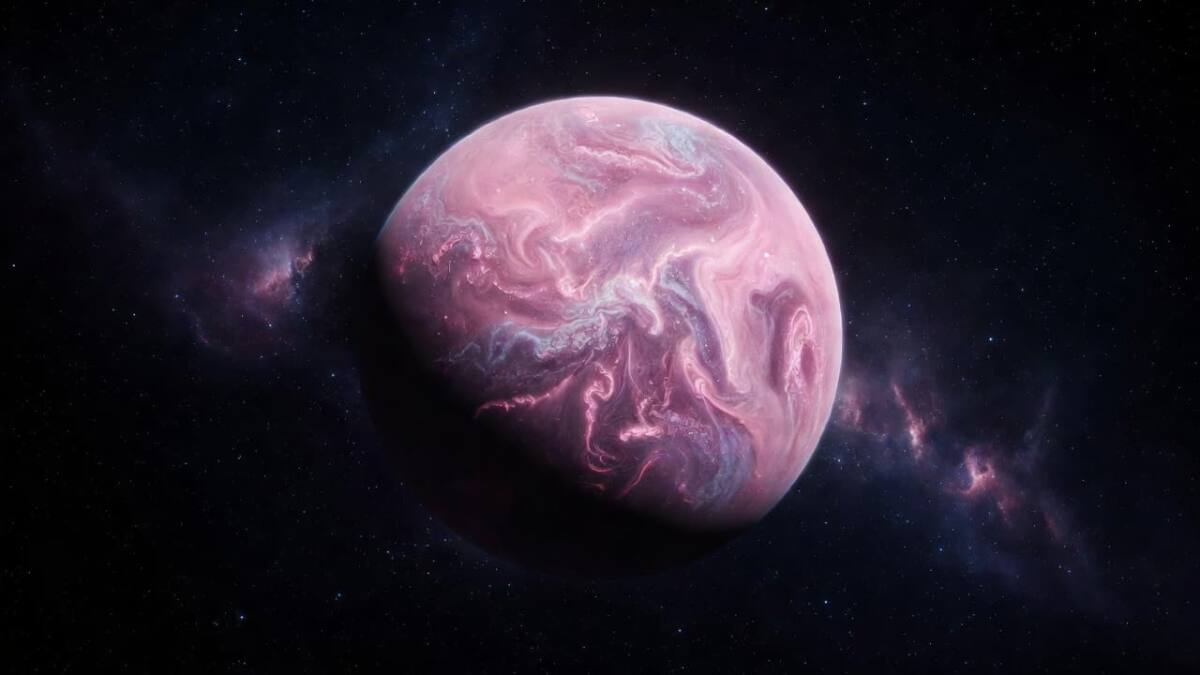
Astronomers have identified an unusual ingredient in the atmosphere of GJ504B: clouds made of mineral salts. The finding helps explain a spectrum that had resisted easy interpretation for years, and it pushes the far-off object even closer to the awkward boundary between giant planets and brown dwarfs.
The object sits about 54 light years from Earth in Virgo and has long been nicknamed ”pink” because of its odd atmospheric appearance. GJ504B is a gas giant, but its atmosphere is relatively cool at about 238 degrees Celsius – not exactly vacation weather, but low enough by giant-planet standards to make exotic cloud chemistry possible.
What JWST found in GJ504B’s atmosphere
The breakthrough came from data gathered by the James Webb Space Telescope, which let researchers model GJ504B’s atmosphere in more detail. Their best fit points to clouds containing potassium chloride, zinc sulfide, and other salt compounds. Alongside those solids, the observations also confirmed water vapor, methane, ammonia, and carbon monoxide.
That mix is a reminder that exoplanet atmospheres do not have to look anything like the polished illustrations in press releases. Hot, odd and chemically busy is the norm. Webb has been especially good at turning those vague colored blobs into actual physics.
A massive object near the planet-brown dwarf line
Researchers also refined GJ504B’s age to between 2.5 and 4 billion years, roughly comparable to Earth’s age. Its mass is now estimated at about 24 to 25 Jupiter masses, which makes it one of the most massive known gas giants and puts it right on the fault line between planets and brown dwarfs.
- Distance from Earth: about 54 light years
- Location: Virgo
- Atmospheric temperature: about 238 degrees Celsius
- Estimated mass: about 24 to 25 Jupiter masses
Why salt clouds matter for exoplanet science
That boundary is more than a naming squabble. Objects this heavy can behave like giant planets in some respects and like failed stars in others, which is exactly why atmospheric composition matters so much: it is one of the few ways to tell what you’re really looking at when the object itself is just a distant point of light.
Expect more of this sort of detective work as Webb keeps feeding astronomers better spectra. The real winner here is not GJ504B, which is still absurdly far away, but the people trying to classify weird worlds without having to guess at the chemistry.