

TCL CSOT is lining up a direct challenge to South Korea’s grip on OLED panels, with TrendForce saying the company has already started mass production of IJP OLED panels on a 5.5-generation line and is preparing laptop production for the third quarter of 2026. The move matters because OLED monitors and laptops are still mostly shaped by a small group of suppliers, and TCL is trying to widen that gate with a printing process that could lower barriers if yields cooperate.
The company has already brought the technology into medical applications, while validation work for branded monitors and notebooks is still underway. TCL CSOT first tested demand with a 27-inch UHD IJP OLED monitor aimed at professionals, a sensible place to start if you want to prove panel quality before flooding the market with bigger plans and harder expectations.
TCL CSOT’s IJP OLED rollout
TrendForce says manufacturers in China, Taiwan, and South Korea are now evaluating the panels. That kind of cross-border sniff test is typical in display supply chains: nobody wants to commit volume until the picture quality, efficiency, and manufacturing consistency hold up outside a lab slide deck.
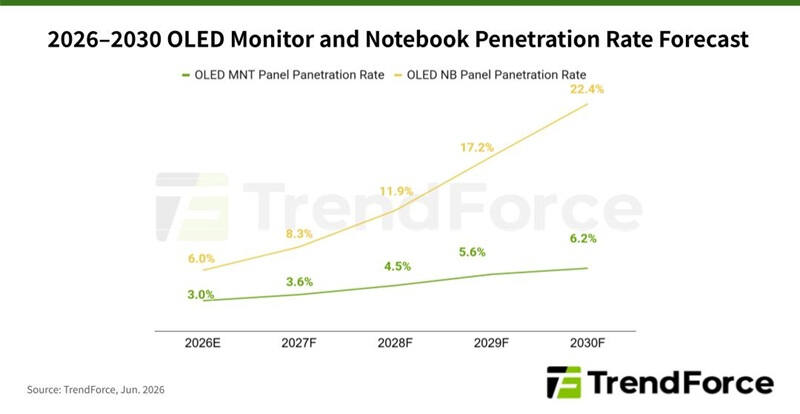
The bigger play is the factory roadmap. TCL CSOT is investing in 8.6-generation OLED capacity for monitors, which could help OLED displays move from a niche premium feature into a more common option. TrendForce expects OLED monitors to account for about 3% of total monitor output in 2026, rising to 6.2% by 2030.
Samsung Display still sets the pace
For now, Samsung Display and LG Display still dominate OLED panels for monitors, which is why the market has stayed relatively tight. A concentrated supplier base keeps volumes limited, and it also keeps prices from falling fast enough to turn OLED into a default choice for every monitor buyer who wants deeper blacks and faster response times.
The laptop side is moving faster. Samsung Display remains the leader there, but TrendForce says Everdisplay Optronics is gaining ground, and TCL CSOT, BOE, and Visionox are all investing in 8.6-generation production. BOE even started production this week in Chengdu for OLED panels used in laptops and tablets, a sign that the next round of competition is already underway.
OLED laptops are spreading beyond one supplier
TrendForce expects OLED panels to reach about 6% of the laptop panel segment this year before climbing to 22.4% by 2030. That is the kind of shift that usually happens once more than one company can make the panels at scale without pricing them like jewellery.
The open question is whether TCL CSOT can turn its printing pitch into consistent notebook volume fast enough to matter. If it does, the real winner may not be any single panel maker, but laptop brands that finally get a less lopsided supply chain to work with.