

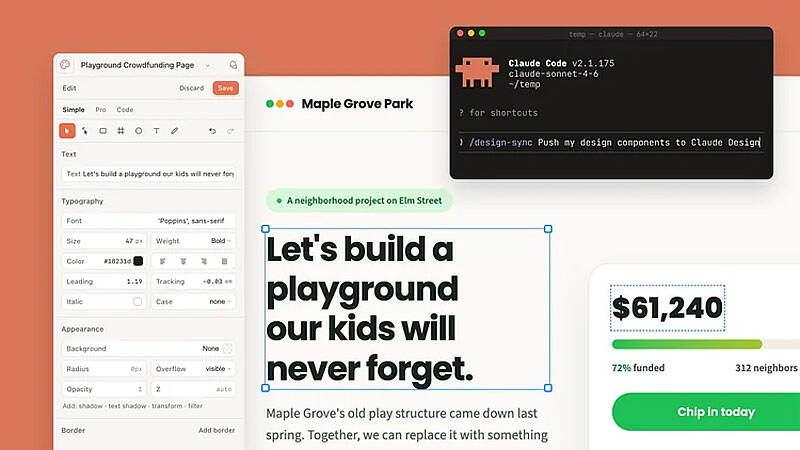
Anthropic has given Claude Design a substantial refresh, tightening its ties to brand design systems, adding more granular interface controls, and cutting token usage so teams can iterate on more ideas without chewing through as much compute. The update pushes Claude Design closer to a serious design companion rather than a flashy demo that falls apart the moment a brand guideline enters the room.
The pitch is straightforward: make the AI more reliable for early-stage design work, then hand the strongest concepts over to human designers and engineers. That is also where the money is for Anthropic, because workflow tools that sit inside a company’s existing process are a lot harder to ignore than novelty generators that produce pretty nonsense.
Claude Design gets finer control over fonts, colors, and buttons
According to designer Nate Parrott, the earlier version of Claude Design struggled with stability and consistency. The new system is designed to generate layouts that stay closer to a brand’s visual identity, while giving administrators better control over the final output.
Anthropic also added more precise editing tools, letting users adjust fonts, colors, layout, and button styles directly in an interactive workflow. That puts the product a little closer to traditional design software, which is probably the point: designers want AI to speed up decisions, not force them to babysit a moody image bot.
Claude Design now uses tokens more efficiently
On the efficiency side, Claude Design has been linked with chat limits as well as Claude Code. Anthropic says that means the platform can handle more tasks for roughly the same token cost, which matters in a world where teams are still learning how quickly AI productivity tools can burn through budgets.
- Better compatibility with design systems
- More detailed controls for fonts, colors, layout, and buttons
- More work per token through tighter resource management
Where Anthropic wants designers to start
The broader goal is to move AI earlier in the product process, where teams can test dozens of concepts quickly before settling on the few worth engineering. That mirrors a wider industry pattern: Disney Imagineering and Adobe have already built their own AI tool for exploring design ideas for Disney parks and cruise ships, which suggests the race is not about replacing designers but about owning the first draft.
That is the smart bet. The open question is whether Claude Design becomes a must-have part of the modern design stack or just another fast way to generate variations until the novelty wears off and the brand team starts asking for the actual pixels.