

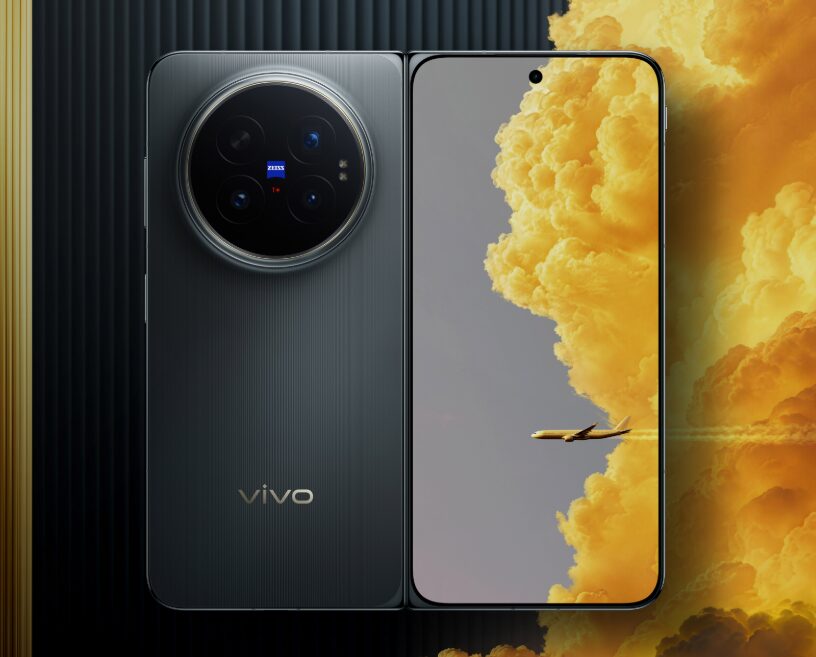
Vivo is pitching the X Fold 6 as a foldable for people who punish phones for a living: travelers, commuters, and anyone who thinks a dead battery is a personal insult. The company has now confirmed the Vivo X Fold 6’s 7,000mAh Blue Ocean battery, IPX8 and IPX9 water resistance, and a broader durability push that includes low-temperature operation and a sturdier hinge.
That is a direct attempt to move the foldable conversation away from ”look at the screen” and toward ”will this thing survive a real day?” Samsung and Honor have spent years trying to make book-style foldables feel less fragile; Vivo is taking the same fight up a notch by leaning hard into endurance and connectivity instead of just raw specs.
7,000mAh battery and semi-solid-state tech
According to Vivo product manager Han Boxiao, every variant of the X Fold 6 will use the 7,000mAh Blue Ocean battery. Vivo says the phone is the first smartphone to use fifth-generation silicon-anode battery technology, paired with its third-generation semi-solid-state battery system.
The company claims that setup delivers up to 9.8 hours of endurance in heavy-load Atomic Workbench testing, which it says is a 30% improvement in battery life. In plain English: this is Vivo trying to make a foldable feel less like a luxury gadget and more like something you can actually forget the charger for.
IPX8 and IPX9 resistance for rougher use
Vivo also showed the X Fold 6 continuing to work at minus 20 degrees Celsius, and another demo had the device operating underwater. The phone carries IPX8 and IPX9 ratings, with Vivo saying it can handle powerful water pressure.
That kind of protection is becoming a bigger selling point in premium phones, especially foldables, where buyers have long been asked to accept a trade-off between innovation and durability. Vivo clearly wants to shrink that gap.
Connectivity is part of the pitch
The X Fold 6 also gets Vivo’s upgraded Global Signal Amplification System 3.0, built around a proprietary 1+4 communication chipset architecture. Vivo says that includes one dedicated signal amplification chip and four Wi-Fi enhancement chips to improve reception in difficult environments.
To make the point, Vivo demonstrated a voice call during a skydive from 4,000 metres. The stunt is a bit theatrical, sure, but the target audience is obvious: people who spend time in trains, lifts, highways and other places where signal bars go to die.
What the Vivo X Fold 6 already confirms
- 8.02-inch foldable OLED inner display
- Up to 5,000 nits of brightness
- Dimensity 9500 Super Edition chipset
- Triple rear camera setup with a 200-megapixel main camera, a 50-megapixel ultra-wide lens and a 50-megapixel periscope telephoto camera
- First Vivo foldable with telephoto extender attachment support
- Configurations: 12GB+256GB, 12GB+512GB, 16GB+512GB and 16GB+1TB
- Colors: Blue Cave, Salt Lake, Polar Night and Black Gold Edition
The expected launch is June 26 in China, with a global debut likely to follow in July. The bigger question is whether Vivo’s battery-and-durability story is enough to pull foldable buyers away from the familiar Samsung-and-Honor playbook, or whether the X Fold 6 ends up as the rare device whose spec sheet is more convincing than the market around it.