

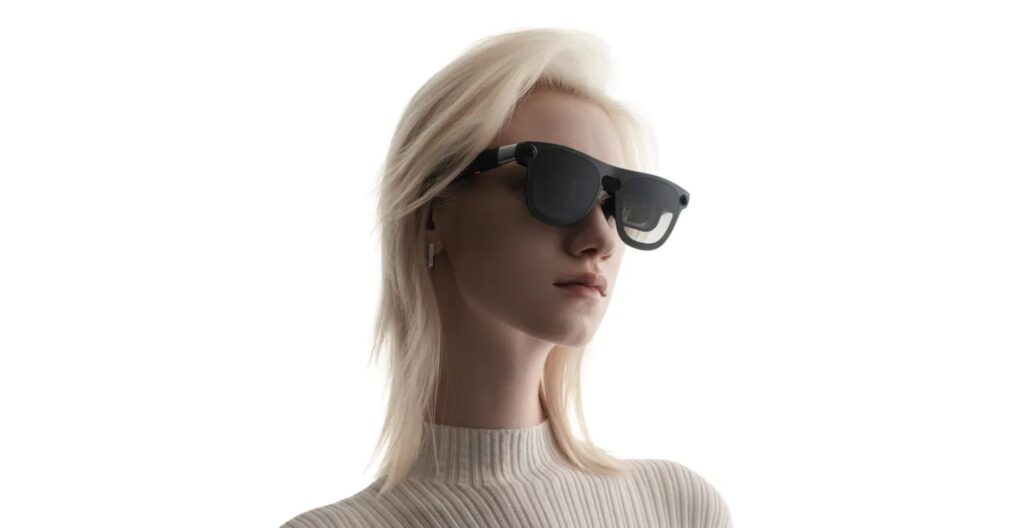
Xreal has pulled the wraps off Aura, its first smart glasses built on Android XR, and the hardware pitch is far more serious than the usual demo-day vapor. The catch is obvious: Xreal is still hiding the final retail price, which is the detail that will decide whether Aura becomes a genuine consumer product or another expensive enthusiast toy.
Unveiled at AWE 2026 after months of teasers under the Project Aura label, the glasses pair Google’s Android XR platform and Gemini integration with Qualcomm’s Snapdragon Reality Elite chipset. That puts Xreal in the same broad orbit as other headset makers betting that AI-assisted interfaces and spatial computing can finally move beyond awkward prototypes.
Xreal Aura hardware and display specs
Aura uses Xreal’s X1S coprocessor for spatial computing and content rendering on an optical see-through display system. The headline specs are solid: a 70-degree field of view, Sony Micro-OLED panels at 1920 x 1200 pixels per eye, and refresh rates of up to 120Hz. Electrochromic dimming is included too, which should help users see more of the screen and less of the real world when they want to focus.
Interaction is handled mainly through hand tracking, with front-facing cameras enabling six degrees of freedom tracking and gesture control. Xreal is also leaning on the kind of details that matter in practice, not in launch slides: a compute puck carries the Snapdragon Reality Elite processor plus a 4,455mAh battery, and the puck can be configured with up to 16GB RAM and 512GB storage.
- Display: 1920 x 1200 pixels per eye
- Refresh rate: up to 120Hz
- Field of view: 70 degrees
- Battery: 4,455mAh in the compute puck
- Memory and storage: up to 16GB RAM and 512GB storage
Xreal Aura reservations are live in three countries
Xreal has opened reservations in the United States, the United Kingdom, and Japan. Buyers can put down $99 for credits toward the final purchase, while a limited Founder Priority Pass costs $299. That is a familiar prelaunch tactic: collect intent now, reveal the pain later.
The company says the base model will cost less than $1,500, but that still leaves a very wide band for shoppers trying to judge whether Aura competes with premium mixed-reality gear or simply borrows its pricing. Later this year, Xreal expects availability in the US, Canada, Japan, South Korea, and the UK, with more European markets to follow after that.
Software support could make or break Aura
Xreal is promising an ecosystem that spans games, productivity tools, and immersive apps, including Fallout: Factions, Demeo, and Cubism. That matters because smart glasses live or die on the quality of their software story; the best hardware in the world is still just a pricey mirror if developers do not show up.
The missing launch date makes the timeline fuzzy, but the bigger question is whether Xreal can turn Aura into something broader than a showcase for Android XR. Meta has already trained consumers to expect aggressive software support in this category, and Apple has set the benchmark for premium hardware expectations. Xreal now has to prove it can do both without making the sticker shock even worse.
What Xreal still has to reveal
The company has answered most of the spec-sheet questions, but the two that matter most are still pending: final price and exact launch timing. Until those are clear, Aura remains a promising concept with real hardware behind it, not a finished product with a market test in hand.