

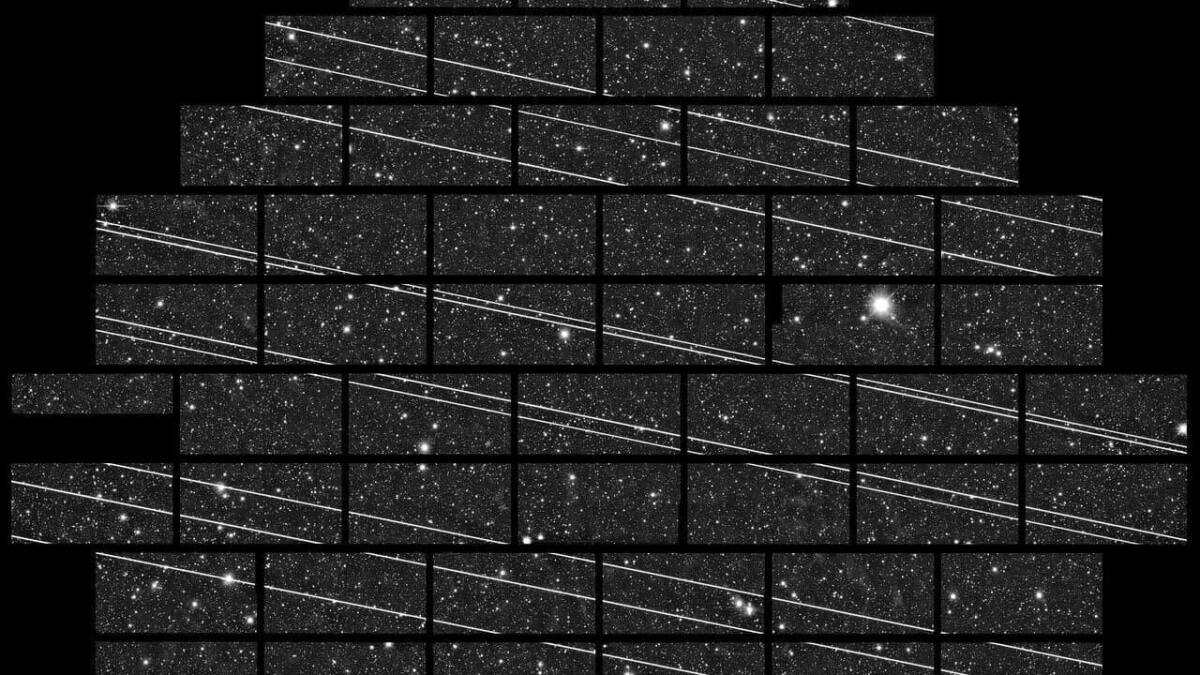
The new SPHEREx space telescope is barely up and already swimming in satellite streaks: more than 73% of its images are contaminated, and the average frame carries 2.18 tracks from commercial spacecraft. The uncomfortable part is that SPHEREx is not a ground telescope looking through a crowded sky from below; it is orbiting at about 700 km, which is supposed to be the safer place.
The finding comes from NASA’s Ames Research Center and adds a blunt data point to a problem astronomers have been warning about for years. Satellite megaconstellations are no longer just an annoyance for long-exposure imaging. They are becoming a direct filter on what observatories can measure, and the cost is not just visual clutter but lost science.
Why SPHEREx is especially exposed
SPHEREx, short for Spectro-Photometer for the History of the Universe, Epoch of Reionization, and Ices Explorer, is designed to map the entire sky in near-infrared light. That kind of work needs long exposures and wide views, which is exactly the sort of observing strategy that makes a satellite track hard to dodge.
The streaks are not random scratches. The study says they often form X-shaped patterns that line up with the orbital planes of large low-Earth-orbit constellations. In other words, the sky is starting to look organized by the business plans of satellite operators, which is a deeply annoying twist for anyone trying to do astronomy.
Why the software fix is not enough
SPHEREx already uses processing meant to suppress cosmic-ray hits, but that machinery can mistake bright satellite trails for particle noise. The result is messy: the center of the streak gets removed, while parallel artifacts remain and contaminate the data around it.
That means the damage is not cosmetic. Photometric information from objects underneath a track can be lost entirely, which is a polite way of saying parts of the observation get cut out of the scientific record. For a survey mission that is supposed to deliver a clean map of the sky, that is a bad trade.
Satellite streaks in SPHEREx images could get worse
- More than 73% of SPHEREx images are already affected.
- The average image contains 2.18 satellite trails.
- Future scenarios in the study put the number of crossings at 189 per image.
- Under those conditions, up to 100% of SPHEREx images could be touched by satellite streaks.
This is not the first time astronomers have measured the damage. Earlier work found that the share of Hubble images crossed by satellites rose from 2.8% in the early 2000s to 5.9% in 2021. That trend matters because it shows the problem is not static; it scales with every new batch of spacecraft that gets launched.
Attempts to make satellites darker do not solve the core issue, the researchers argue, because newer spacecraft are also becoming bigger and brighter. That leaves astronomy stuck in an awkward race against an industry that keeps adding more reflective objects to orbit.
The open question is no longer whether orbital pollution will affect science. It already does. The real question is how much of the sky can stay usable if satellite fleets keep expanding at this pace, and whether the rules governing launches will ever catch up with the telescopes they are now shadowing.