

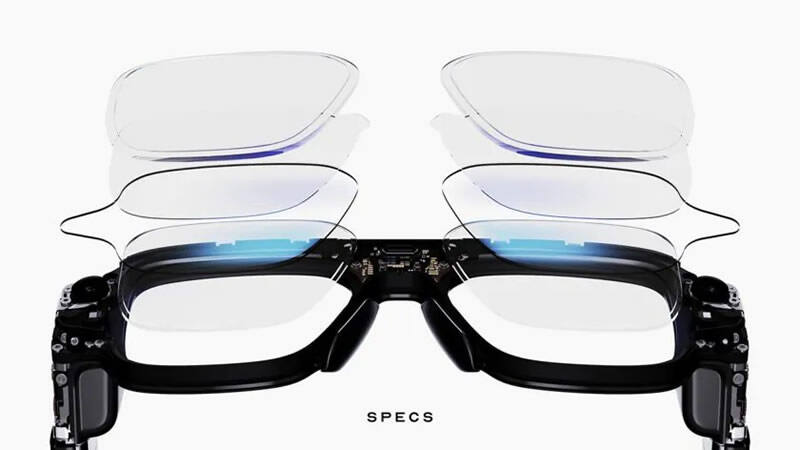
Snap has finally put a price and a timetable on its next push into augmented reality. The company’s Specs AR glasses, unveiled at Augmented World Expo 2026, are pitched as consumer-ready hardware with electrochromic lenses, up to 20 hours of battery life via the charging case, and a privacy setup that tries to calm the usual ”are these things filming me?” panic.
At $2195, they are still expensive enough to make normal shoppers blink twice, but the hardware reads like a serious attempt to get past the toy phase that has haunted smart glasses for years. Meta, Apple, and others have spent years teaching the market that wearable AI needs to look less ridiculous and work more reliably; Snap is clearly trying to borrow that playbook while keeping its own Lens ecosystem front and center.
Snap Specs AR glasses: 51-degree field of view and 7 millisecond latency
Snap says Specs use two Snapdragon chips to split the workload between computer vision and its own Lens experiences. The company claims a 7 millisecond delay between movement and image, a 51-degree field of view, and support for 16 million colors. That is the kind of spec sheet meant to reassure developers that this is not just another ”nice concept, terrible demo” gadget.
The waveguide has also been redesigned to cut down distortions in the outside world, which sounds boring until you remember how many AR products have looked fine in marketing photos and grim in daylight. Snap is aiming at the everyday usability problem that has slowed the whole category: if the glasses feel awkward, heavy, or visually messy, nobody wears them long enough for the software to matter.
Battery life, privacy and local processing
Battery life is one of the more believable talking points here. Snap says the glasses last four hours on their own for audio, video, notifications and AI replies, while the included case provides four full recharges and takes total use to 20 hours. That puts Specs closer to a day-trip device than a desk-only demo, which is where AR wearables need to be if they want any kind of mainstream shot.
- Price: $2195
- Standalone battery life: four hours
- Total battery life with case: 20 hours
- Field of view: 51 degrees
- Latency: 7 milliseconds
Privacy is another pressure point, and Snap is responding with a recording light and consent prompts before accessing sensitive data. The company also says most processing happens locally on the device, a sensible move in a category where ”cloud-first” can sound a lot like ”we may be watching you.” In Europe and the US, that kind of positioning is becoming less optional and more like table stakes.
Lens Studio gets a developer boost
Snap is pairing the hardware launch with updated developer tools, including Lens Studio agent integration with Claude Code, Codex and Cursor. That matters because no AR glasses win on hardware alone; they win when developers can build useful things fast enough to justify the awkward glasses phase.
The company also introduced Specs Spatial, a benchmark for measuring how neural networks perform on real-world spatial tasks. That is a smart move, because it gives Snap a way to frame the competition around practical performance rather than marketing gloss. If third-party developers and AI partners start treating Specs as a serious platform, the product has a chance to become more than another expensive prototype for early adopters with deep pockets.
Preorders are open, but the real test starts in autumn
Preorders are already open on Snap’s site, and sales are set to begin in autumn in the US, the UK and France. That rollout is narrow enough to suggest a cautious launch, which is probably wise: AR glasses still need to prove they can be worn in public without feeling like a compromise between a phone, a headset and a privacy headache.
The bigger question is whether Specs can pull buyers beyond the usual developer crowd. If Snap’s bet works, it may finally show that smart glasses can be sold as a premium consumer device rather than a promise for some future keynote. If not, the company will have produced another very polished reminder that augmented reality is still waiting for its breakout moment.