

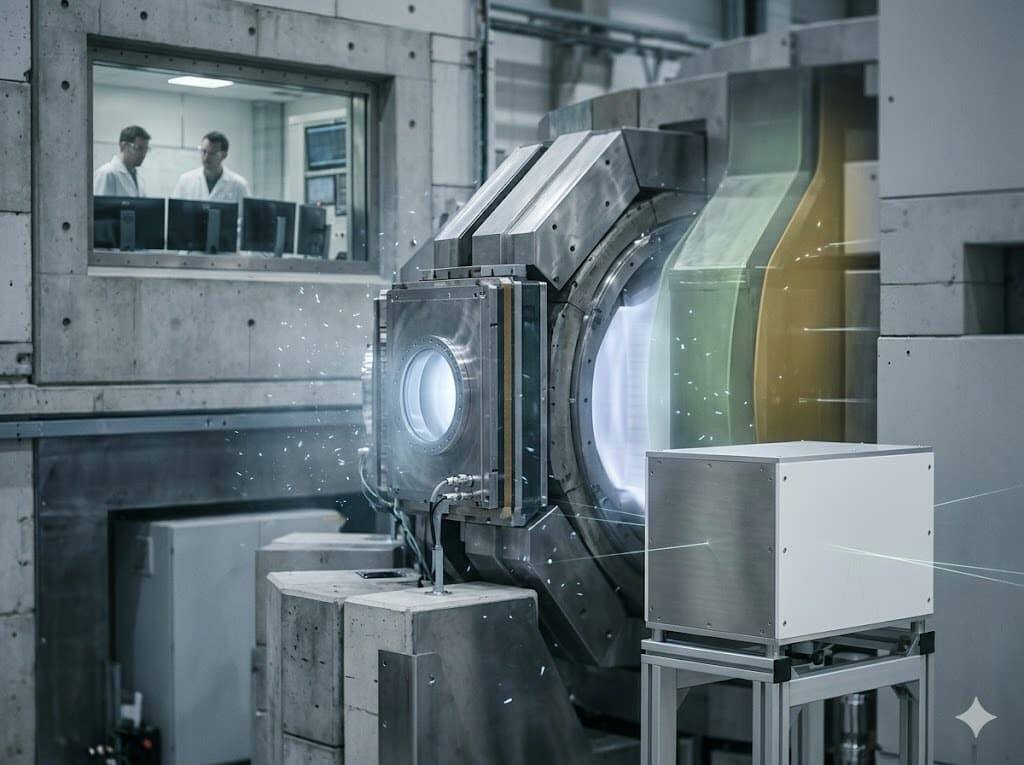
A compact antineutrino detector may be able to spot the covert production of several kilograms of plutonium-239 inside a fusion reactor within 30 days, according to researchers at Virginia Tech. The pitch is simple enough to make arms-control officials smile for once: if future fusion plants can make fuel, they can also make trouble, and physics may be the easiest watchdog in the room.
The study looks at a very specific risk in deuterium-tritium fusion systems. These reactors are expected to flood their blankets with 14.1 MeV neutrons, which is great for energy production and awkward for anyone worried about a hidden uranium-238 feedstock turning into plutonium-239. That is the same material that has long sat near the center of proliferation fears in fission, only here it could be produced behind a wall of concrete and steel.
How the antineutrino detector would spot hidden plutonium
The proposed monitor relies on inverse beta decay, the standard antineutrino detection reaction with a 1.806 MeV threshold. Because antineutrinos cannot be screened out or faked by ordinary chemistry, they offer a rare signature of what is happening inside a reactor core and its surrounding blanket. The trick is separating that signal from the reactor’s own baseline and from the natural antineutrino background already washing through the planet.
In the model, a detector with a mass of about one ton could sit outside the reactor building and still pick up the telltale change within 30 days. That matters because it points to remote verification without opening the machine up, which is a much nicer option than hoping every operator on Earth stays honest forever.
FLiBe and DCLL blanket designs behave differently
The researchers tested two blanket architectures: a molten-salt FLiBe design and a lithium-lead dual-coolant loop, or DCLL. They did not pick those names to win a dinner conversation; these are among the more plausible breeding and heat-transfer concepts for future fusion plants, and both could create different neutron-reaction fingerprints that affect what the detector sees.
FLiBe uses lithium-6 enrichment of about 20%, while the DCLL concept can push lithium enrichment to 90%. Those choices change the secondary reactions, the activation products, and the level of background noise from structural materials. Some isotopes barely show up in inverse beta decay at all, which is exactly the kind of detail that makes a monitoring scheme sound boring in the best possible way.
Why fusion safeguards are becoming a design problem
The broader story is that fusion is moving from lab science toward commercial plant design, and safeguards are no longer an afterthought. That is not unique to fusion: every new nuclear technology eventually runs into the same question of how to prove it is doing the job it claims to do. The difference here is that a detector could do the job passively, outside the reactor, and without interrupting operations.
That could make antineutrino monitoring attractive for international inspection regimes, especially for reactors not yet built but already being designed with oversight in mind. The open question is how far this goes in practice: a one-ton detector in a paper model is promising, but real plants are messy, and proliferation officers tend to prefer evidence that survives contact with concrete, steel, and budget cuts.