

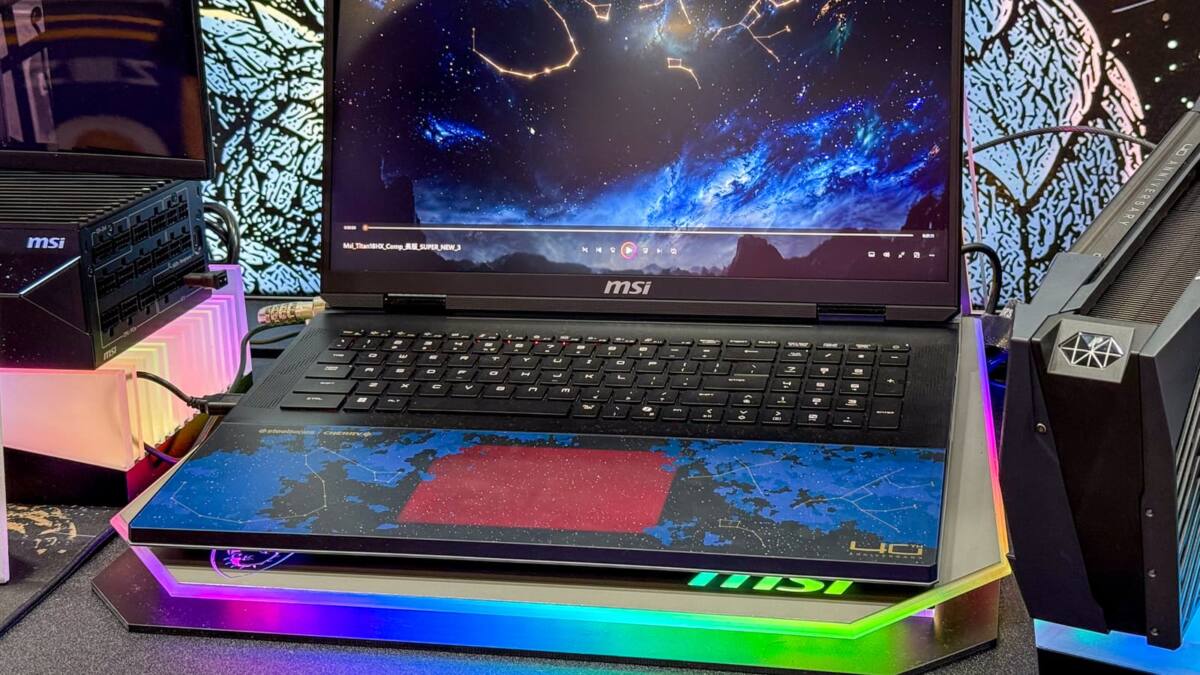
MSI used Computex 2026 to show two very different ideas of ambition: a 3.6 kg monster built to flex every component in the catalog, and a set of thinner machines that try to make that power feel less absurd. The headline act was the Titan 18 HX Dragon Edition Draco Epic, but the broader MSI Computex 2026 lineup also includes the Raider, Katana, Prestige, and Claw as MSI chases gamers, creators, and AI buyers at once.
The company’s message is simple enough. If you want maximum specs, it has you covered; if you want something more practical, it still has a slot for you. That split is increasingly common at major PC shows, where the fight is no longer just about raw performance but about who can package it in the most usable, desirable form.
Titan 18 HX Dragon Edition Draco Epic
The Titan 18 HX Dragon Edition Draco Epic is MSI’s 40th-anniversary showcase machine, with a decorated chassis, metal relief details, and a bundle that can include a premium box, commemorative coin, gaming mouse, and mouse pad depending on the country. Under the flashy shell sits an Intel Core Ultra 9 290HX Plus, GeForce RTX 5090 Laptop GPU with 24 GB of GDDR7, up to 128 GB of DDR5, and four M.2 slots, including one PCIe 5.0.
MSI pairs that hardware with an 18-inch Mini-LED display at 3840×2400 and 240 Hz, full DCI-P3 coverage, VESA DisplayHDR 1000 certification, Cherry MX Ultra Low Profile mechanical keys, six Dynaudio speakers, dual Thunderbolt 5 ports, HDMI 2.1, Wi-Fi 7, and a 99.9 Wh battery. It is trying to sell the idea of a desktop replacement, even if the 3.6 kg weight says ”portable” in the same way a small suitcase does.
Raider 16 Max HX and Katana 15 HX
Raider 16 Max HX is the more disciplined version of that same philosophy. MSI says the top configuration, with Core Ultra 9 290HX Plus and GeForce RTX 5090 Laptop GPU, can reach up to 300 W total in Apex Performance mode on AC power, with up to 175 W for the GPU and 125 W for the CPU. To make that fit in a 16-inch chassis, MSI shrank the motherboard and expanded the cooling system with three fans, six heat pipes, and five exhaust zones.
That model also gets a 16-inch QHD+ panel at 240 Hz, optional OLED with DisplayHDR True Black 1000, up to 128 GB of DDR5-6400, two M.2 slots, a 91.8 Wh battery, a 400 W adapter, and a 2.6 kg weight. Katana 15 HX is the more accessible pitch: up to Core i9-14900HX, up to GeForce RTX 5070 Laptop GPU with 8 GB of GDDR7, up to 170 W total power, a 15.6-inch Full HD 144 Hz display, two DDR5 slots up to 96 GB, and two PCIe 4.0 M.2 bays. In plain English, it is MSI’s entry ticket into the RTX 50 series crowd.
- Raider 16 Max HX: up to 300 W total power, RTX 5090 Laptop GPU, 2.6 kg
- Katana 15 HX: up to RTX 5070 Laptop GPU, 144 Hz Full HD display, about 2.2 kg
Prestige 14 Flip AI+ Vincent van Gogh Edition
Not everything on the booth was about brute force. MSI also put the Prestige 14 Flip AI+ Vincent van Gogh Edition front and center, part of its Artisan Collection and dressed around ”The Starry Night” and ”Starry Night Over the Rhône”. The company says it used layered blues, textures, and lighting transitions rather than a simple print, and the package includes a wireless mouse, themed mouse pads, a sleeve, and a keyboard cover.
Inside are an Intel Core Ultra 9 378H, Intel Arc B390 graphics, up to 64 GB of LPDDR5x, and a PCIe 4.0 M.2 drive. The 14-inch OLED display runs at 1920×1200 with full DCI-P3 coverage and pen support, while the 360-degree hinge turns it into a tablet when needed. At 11.9 mm thick and 1.37 kg, it is the most mobile machine MSI showed, and the promised up to 30 hours of 1080p video playback is the kind of claim that always deserves a raised eyebrow.
Prestige N16 Flip AI+ and Claw 8 EX AI+
MSI’s more experimental move is the Prestige N16 Flip AI+, its first laptop on Nvidia RTX Spark. This is not a normal GeForce RTX machine, but a thin Windows device built around Nvidia’s unified superchip concept with Grace CPU, Blackwell RTX graphics, and up to 128 GB of shared memory. MSI positions it for content creators, developers, AI engineers, and gaming, but the catch is that the company showed only mockups on the stand, so the hardware is still more promise than product.
The final new arrival was the Claw 8 EX AI+, a Windows handheld that becomes MSI’s first console on Intel Arc G3 Extreme with integrated Intel Arc B390 graphics. It comes with 32 GB of LPDDR5x, a PCIe 4.0 x4 M.2 2280 SSD, an 8-inch 1920×1200 display up to 120 Hz, Hall-effect sticks and triggers, two Thunderbolt 4 ports, microSD, fingerprint unlock, stereo speakers, an 80 Wh battery, and a 785 g body in Void Purple. The handheld market has already punished slower updates and half-hearted specs elsewhere; MSI seems to know it cannot afford that mistake here.
The open question is whether MSI can turn this broad lineup into more than a showcase of engineering muscle. The Titan will grab the headlines, the Katana should sell in volume, and the Prestige models give the brand something to wave at creators and AI buyers, but the real test is whether those categories stay distinct long enough to justify all the badges.