

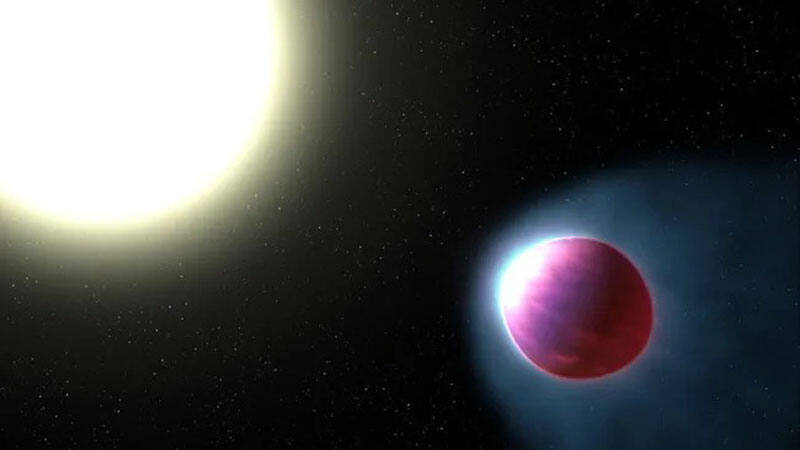
The James Webb Space Telescope has mapped a surprisingly lopsided atmosphere on WASP-121b, an ultra-hot Jupiter 880 light-years away that circles its star in 30.5 hours. The planet’s day-night divide is extreme even by exoplanet standards: winds can reach 18,000 km/h, metals can evaporate on the sunlit side, and on the colder side some of that material may condense into exotic rain, including rubies and sapphires.
That sounds like science fiction with a budget, but the new observations do something more valuable: they turn one of the most violent atmospheres known into a test case for planetary climate models. Webb’s transit spectroscopy lets astronomers watch starlight filter through the planet’s air, revealing how temperature and chemistry change from one hemisphere to the other.
WASP-121b’s day-night temperature split
The standout result is simple and strange. The atmosphere at the boundary from day to night is hotter than the opposite transition zone from night to day. Because WASP-121b is tidally locked, one side permanently faces its star, so the most plausible explanation is fierce heat transport by high-speed winds sweeping energy around the planet.
That asymmetry also shows up in the chemistry. Webb picked up differences linked to water vapor and carbon monoxide, with water molecules likely breaking apart in the hottest regions. On the morning side, cooler temperatures may even allow silicate clouds to form, which is about as far from a comfortable forecast as you can get.
Why WASP-121b is such a good target
WASP-121b sits about 880 light-years from Earth, yet its extreme closeness to its star makes it unusually easy to study in atmospheric detail. That is the irony of ultra-hot Jupiters: they are brutal worlds, but they are also among the best laboratories for seeing how irradiation, winds, and chemistry interact on giant planets.
- Orbital period: 30.5 hours
- Wind speeds: up to 18,000 km/h
- Distance from Earth: about 880 light-years
What Webb could reveal about other ultra-hot Jupiters
The real payoff is broader than one spectacular planet. If the same method keeps working, astronomers will be able to compare atmospheres across other ultra-hot Jupiters and build a more realistic picture of how giant planets evolve under extreme heating. For now, Webb has shown that even a world with mineral rain can still have a readable weather report – provided you have the right telescope and a very strong stomach for bad weather.