

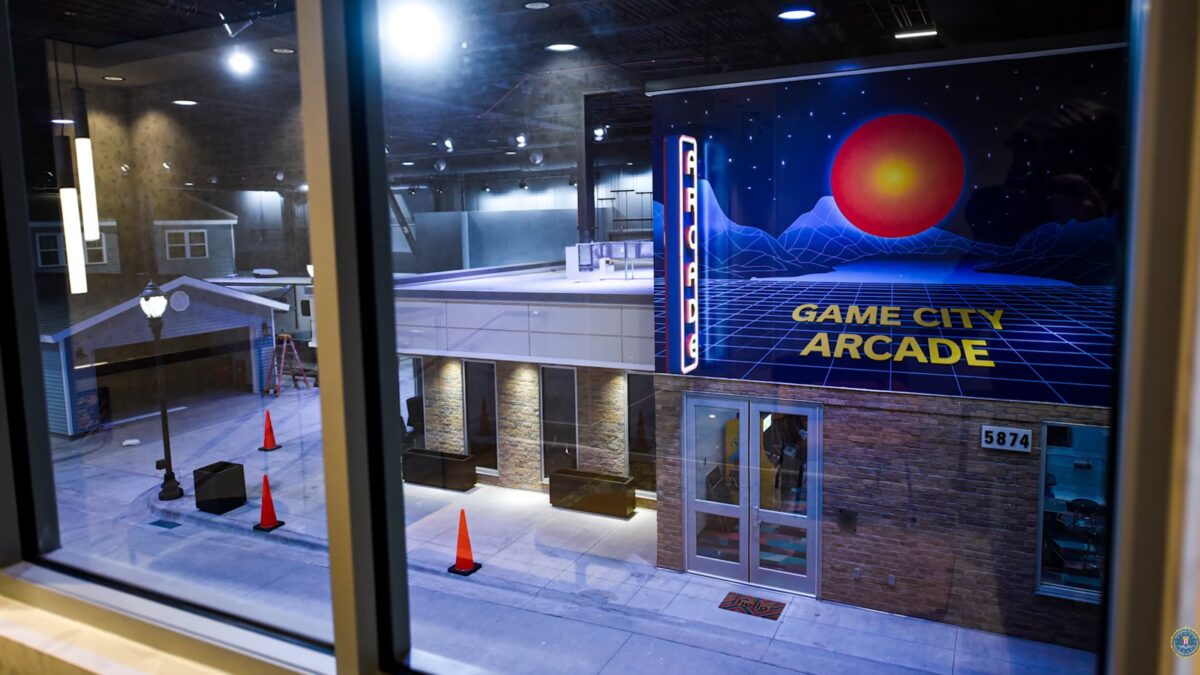
The FBI has built a miniature city in Alabama that looks ordinary on the surface and hostile underneath: a store, gas station, hospital, and furnished homes, all wired together inside a fully isolated cyber training range. The agency has now shown the setup publicly for the first time, and the headline feature is hard to miss – a data center inside the mock town with more than 200 servers ready to be attacked, defended, and probably broken in creative ways.
The facility, called Kinetic Cyber Range, sits in Huntsville and spans 22,000 square feet, or 2,050 square meters. That kind of physical realism is the point. Cyber defenders learn faster when the fake world behaves like the real one, especially now that attacks increasingly blend software, connected devices, and infrastructure that used to be boring enough to ignore.
What the FBI built in Huntsville
Kinetic Cyber Range is not a generic lab with rows of laptops and some sad fake firewalls. It is designed as a full urban environment where systems inside the buildings are networked together just as they would be in an actual town. The city is physically cut off from the external internet, which makes sense if you are trying to simulate attacks without accidentally creating a very expensive public incident.
That isolation also makes the place more useful than a standard classroom setup. A contained environment lets trainers test how intrusions spread, how critical services fail, and how responders coordinate when the target is not just a server but an entire connected ecosystem.
Why a fake town beats a fake dashboard
The scenarios the FBI says it will run there cover everything from smart vehicles to critical infrastructure. That is a smart move, because real-world cyberattacks no longer stop at email phishing or one compromised endpoint. They increasingly run through the messy middle where building systems, transport, and public services overlap.
There is also a broader training trend here. Law-enforcement and military cyber units have spent years moving from abstract simulations to more physical, city-scale ranges, because modern incidents are less about a single breach and more about what happens after the breach touches the real world. The FBI is simply putting its own version of that doctrine into concrete form.
The new school of cyber training
The agency framed the site as a digital counterpart to its traditional tactical training grounds, but with the focus shifted toward modern cybercrime. That is the right evolution. If defenders are going to prepare for attacks on connected cities, they need a place where a hospital, a gas pump, and a server rack can all fail in the same afternoon.
The open question is how far this model spreads. If the FBI gets value from a city-sized cyber range with more than 200 servers, other agencies and large infrastructure operators will want their own version – and they will want it yesterday, before the next attack proves the point for them.