

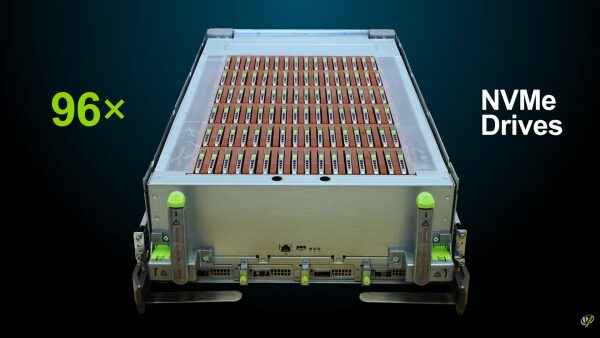
Wiwynn has shown one of the first storage servers built around NVIDIA SCADA, a hardware stack aimed at pushing data-heavy AI workloads past the usual CPU bottlenecks. The headline numbers are very aggressive: 96 EDSFF E3.S SSDs, four RTX Pro 6000 Blackwell Server Edition accelerators, fully liquid cooling, and up to 2,949 PB of flash capacity in a single 6U chassis.
That kind of design is a direct answer to the way modern AI systems actually behave. Vector search, RAG, graph analytics, and KV-cache lookups all hammer storage with tiny, constant requests, and traditional servers spend too much time coordinating the work instead of moving data. GPU-driven storage is Wiwynn’s bet on a different model: let accelerators handle I/O and transaction handling, then hand the data off quickly to compute nodes.
Wiwynn’s 6U MGX chassis and core hardware
The server is built in a 6U MGX chassis meant for a standard 19-inch rack. Wiwynn says it can use either NVIDIA Vera, with 88 Olympus cores, or Intel Xeon in an HPM configuration, and the system includes eight DDR5 memory slots. It also carries four PCIe 6.x switches and four 800G ConnectX-9 SuperNICs or BlueField-4 DPUs, with the option to swap GPUs for DPUs.
- 96 EDSFF E3.S SSD bays with vertical loading
- 4 RTX Pro 6000 Blackwell Server Edition accelerators
- 4 PCIe 6.x switches
- 4 800G ConnectX-9 SuperNIC/DPU BlueField-4 cards
- 8 DDR5 slots
2,949 PB capacity, 528 million IOPS, and 9 kW power draw
Wiwynn says the design can reach 2,949 PB when fitted with Micron 9650 Pro drives at 30.72 TB each using a PCIe 6.0 interface. It is also rated at up to 528 million random-read IOPS, which is the sort of number that tells you this is not a polite enterprise box for file shares.
There is a price to that speed: maximum power consumption is 9 kW, with 50V DC input. That is a lot of heat to move, which explains the fully liquid-cooled layout and the side nooks for power cables and flexible coolant hoses. Those details also make hot-swapping SSDs easier, which is handy when you have 96 of them and no patience for downtime.
Why GPU-based storage is getting attention
The bigger story is not just Wiwynn’s box, but the direction the industry is taking. As AI inference systems grow more storage-intensive, vendors are trying to collapse the distance between data and compute, and NVIDIA is clearly pushing to own more of that stack. Wiwynn’s server is another sign that storage is no longer being treated as a passive box at the edge of the rack; it is becoming part of the acceleration layer itself.
Expect rivals to answer with similar designs from the usual suspects in enterprise infrastructure, especially as PCIe 6.x, 800G networking and denser EDSFF formats move from slide deck to shipping hardware. The open question is whether customers will embrace a GPU-first storage model as a mainstream architecture, or reserve it for the kind of AI workloads that are already chewing through everything else in sight.