

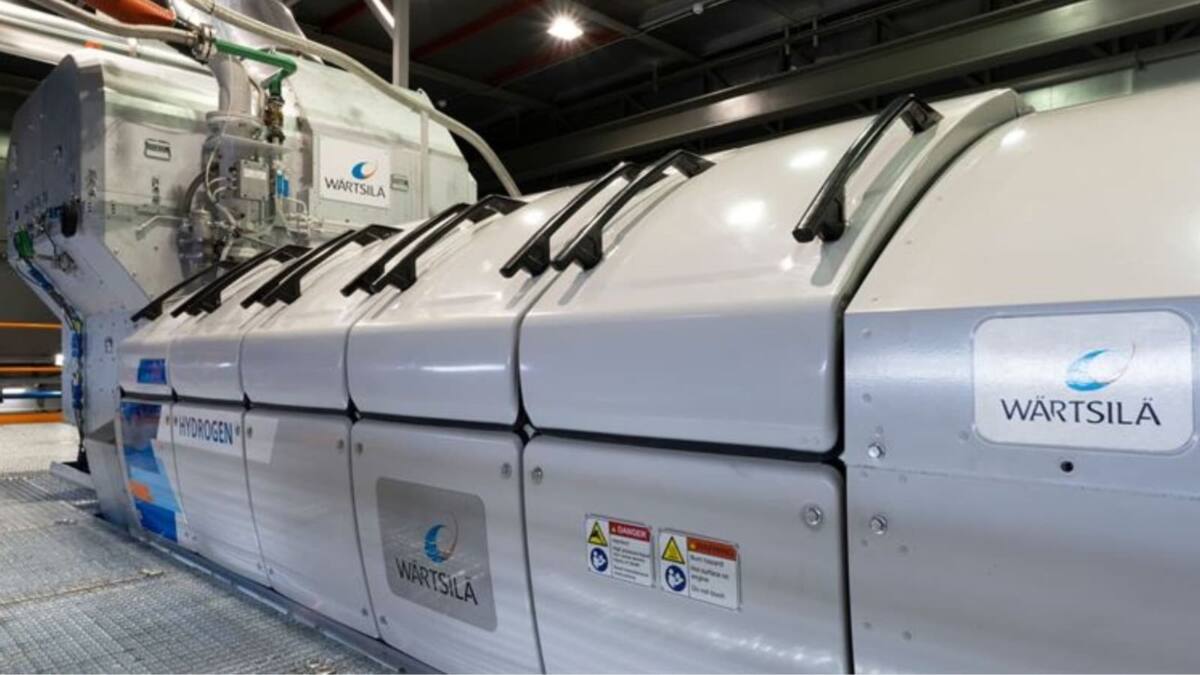
A Finnish company says it has successfully tested the world’s largest industrial engine running on pure hydrogen, and the machine is already sending electricity into Spain’s national grid. Wärtsilä’s 31H2 unit was installed at an energy site in Bermeo and ran on 100% hydrogen, with no natural gas or other fossil fuel blended in.
That makes the Wärtsilä 31H2 one of the clearest real-world demonstrations yet of a hydrogen engine feeding the grid. Most hydrogen power systems still lean on mixed fuel, which makes them a bridge technology at best. This one is trying to skip the training wheels and go straight to the real thing.
What the Wärtsilä 31H2 is designed to do
Wärtsilä sees the engine as more than a headline-grabber. The pitch is that hydrogen can help smooth out one of the ugliest problems in renewable power: supply that rises and falls with the weather.
In practice, the model is straightforward. Excess electricity from solar and wind farms is used to produce so-called green hydrogen through water electrolysis. That hydrogen can then be stored and burned later, when demand spikes or renewable output drops.
Why grid operators care about hydrogen storage
Europe has spent years building more wind and solar capacity, and the result is a cleaner grid with a new headache: variability. Batteries help, but they are not always the right tool for long-duration backup, especially when the gap is measured in hours or days rather than minutes.
That is where hydrogen keeps getting another chance. It is inefficient compared with direct electrification, sure, but it offers something the grid badly wants: storage that can sit around for longer periods without tying up expensive battery capacity.
Data centers are another obvious target
Wärtsilä is also aiming at data centers, especially the giant AI-heavy facilities that now face two pressures at once: constant power demand and growing scrutiny over emissions. Hydrogen engines can be used as backup or primary power sources, giving operators a way to chase reliability without direct carbon dioxide emissions at the point of use.
That pitch lands at a time when tech companies are looking for anything that can keep servers running without provoking local grid fights. If hydrogen power can scale beyond pilot projects, it could become one of the few ways to pair industrial-scale reliability with cleaner electricity – a useful trick, even if it is not the cheapest one on the menu.
What happens after the Bermeo test
The big question is not whether the engine ran once. It is whether more utilities, industrial operators, and cloud providers are willing to build the surrounding hydrogen infrastructure needed to make this repeatable and affordable. The machine is impressive; the fuel chain will decide whether it becomes routine.