

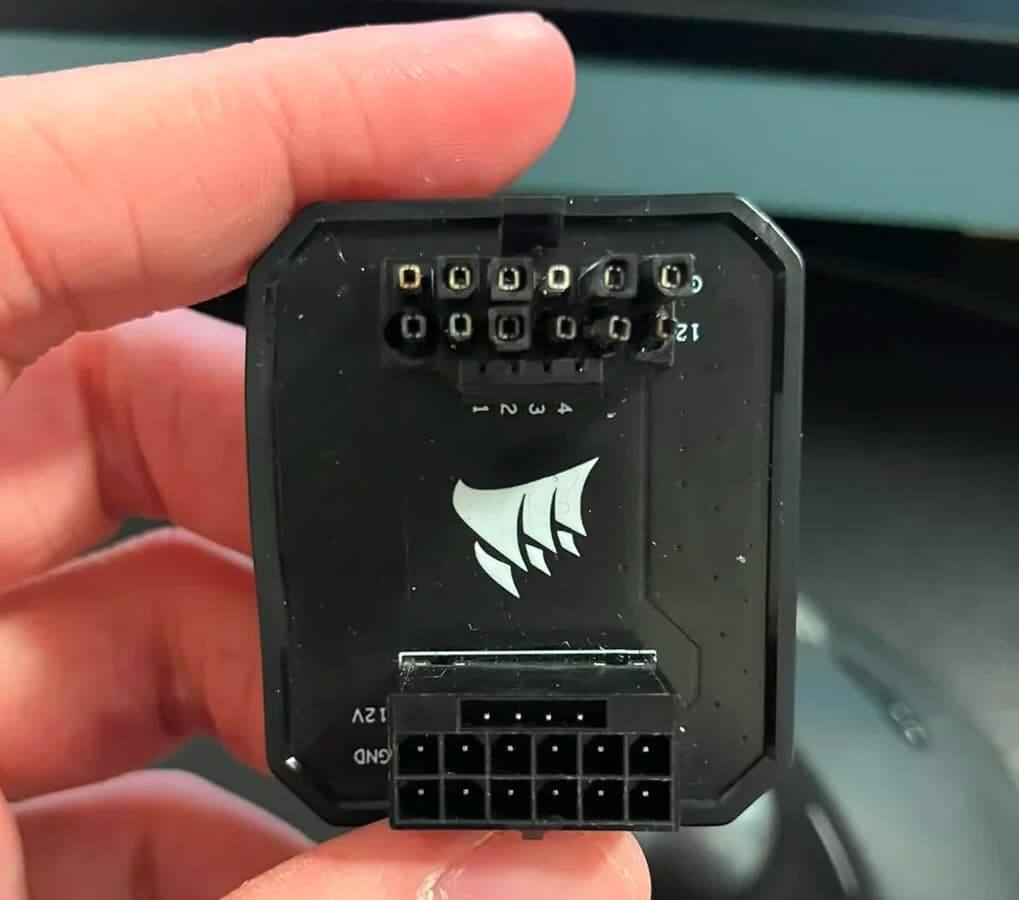
A Corsair GPU Power Bridge sold as a safer way to manage Nvidia’s 16-pin power connector has allegedly done the opposite: it melted during use and damaged a GeForce RTX 4090 Founders Edition. The case, posted on Reddit, is another uncomfortable reminder that 12VHPWR and 12V-2×6 headaches are not limited to the cheapest included cable in the box. Fancy branding does not make physics any less rude.
The device in question is the Corsair GPU Power Bridge, a 180-degree PCIe 5.0 adapter designed to reduce strain on the graphics card’s power plug. Corsair markets it as a high-temperature, high-reliability solution, with support for up to 55 A. In this instance, the user said the PC froze and rebooted while gaming, and the adapter later showed visible melting along the top row of contacts.
What the Corsair GPU Power Bridge is supposed to do
These adapters exist because Nvidia’s 16-pin power connector has become a reputation problem of its own. The whole point of an angled bridge is mechanical: ease cable bend pressure near the socket and make installation less awkward inside cramped cases. That is the promise, at least. If the adapter becomes the weak link instead, the premium label starts to look more decorative than reassuring.
- Device: Corsair GPU Power Bridge
- Type: 180-degree adapter for PCIe 5.0 graphics cards
- Claimed rating: up to 55 A
- Reported damage: melted adapter and affected power connector on a GeForce RTX 4090 Founders Edition
Warranty luck ran out at the wrong moment
The user said the adapter was already out of warranty, while the RTX 4090 was still covered. Nvidia reportedly accepted the card for diagnostics under its return process, but there is no final decision yet on repair or replacement. That split is almost comically unfair, though it is also exactly the kind of mess buyers get when one part of the power chain carries all the risk and another part carries the bill.
The Corsair GPU Power Bridge costs about 25 euros in Europe, which is not much money until it starts taking out a flagship GPU. The episode also follows a similar case involving Asus’ ROG Equalizer cable, which was meant to prevent connector overheating but allegedly melted itself instead. The pattern is getting harder to wave away as bad luck.
Why these 16-pin fixes keep failing
The broader problem is that every new workaround for the 16-pin connector seems to inherit the same anxiety: enough current, enough heat, enough room for a bad bend, and suddenly a ”solution” becomes another failure point. Nvidia, Corsair, Asus, and others may keep shipping more polished accessories, but the market is already judging them by the same blunt standard: do they survive real gaming loads, or do they end up as expensive evidence?
The next question is whether users trust these adapters at all after another public meltdown, or whether the old-fashioned answer wins again: fewer adapters, straighter cables, and a lot more caution around power delivery on top-end GeForce cards.