

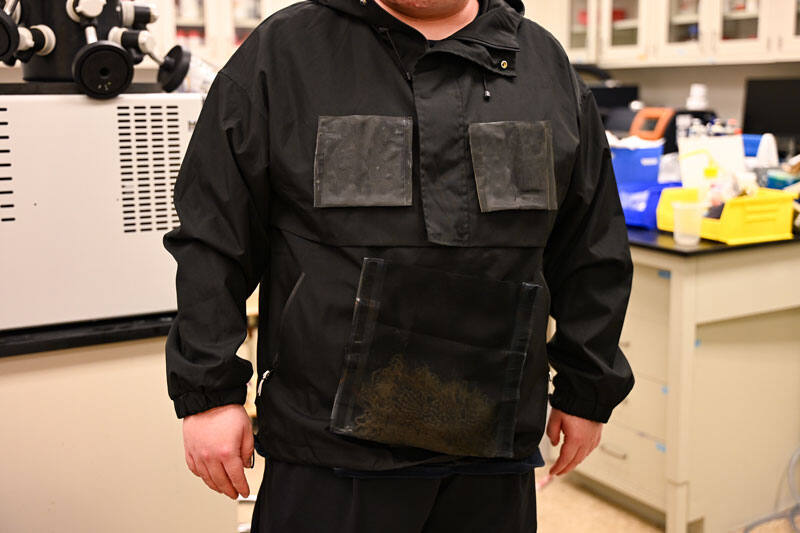
Researchers at the University of Texas at Austin have built a water-collecting jacket that pulls moisture from the air and turns it into drinking water, a science-fiction idea that now sounds a lot less theatrical. Depending on the climate, the garment can collect 400 to 900 ml of potable water a day, with one test producing 1.3 liters in 24 hours.
The appeal is obvious: no bottles to haul, no stream to find, no battery-pack gadgetry to babysit. It is the kind of invention that looks tailor-made for desert treks, emergency response, and military kit, which explains why water-from-air tech keeps showing up in labs from arid-state universities to defense-funded research programs.
How the water-collecting jacket works
The jacket uses a special textile made from fibers that concentrate atmospheric moisture on their surface, turning water vapor into liquid droplets. From there, the liquid is routed into small storage pockets, which are removed and placed in a collector under sunlight to produce clean drinking water.
The team says the material outperformed conventional atmospheric absorbents by 3-10 times. That is the sort of margin that gets attention, because most water-harvesting materials struggle to balance capacity, speed, and portability at the same time.
Test results in Texas and Austin
The experimental jacket was tested in both dry parts of Texas and in Austin’s more humid air, and it worked in both settings. The researchers also reported 4.3 liters of moisture per 1 kg of absorbent material, a metric that hints at how the system could scale beyond a single piece of clothing.
- Daily drinking water output: 400 to 900 ml
- Peak result reported in testing: 1.3 liters in a day
- Moisture captured per 1 kg of absorbent: 4.3 liters
- Performance vs. standard materials: 3-10 times better
From jacket to field gear
The bigger opportunity is not a fashion line for survivalists. If the material can be adapted for backpacks, tents, and other gear, it could become useful for hikers, rescuers, and anyone operating far from a tap. The researchers say they are already working on that next step, which is usually where promising lab demos either become real products or vanish into the great archive of almost-useful prototypes.