

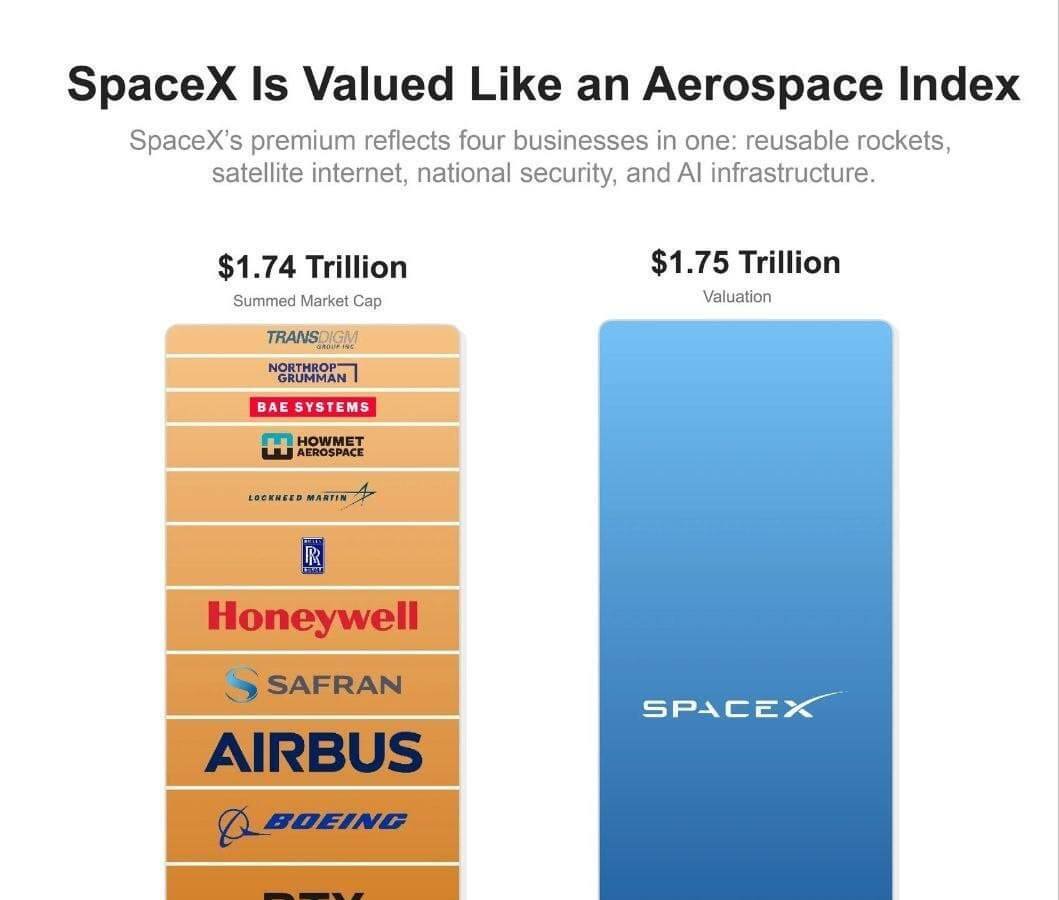
SpaceX has crossed a line that would have sounded absurd not long ago: its market value is now higher than a long list of the world’s biggest aerospace names combined, including Airbus, Boeing, and Rolls-Royce. The valuation follows a private funding round and puts Elon Musk’s company in a completely different league from the traditional aerospace industry it keeps disrupting.
The comparison is especially striking because it is not just about aircraft makers. The tally also sweeps in major engine and systems suppliers such as GE Aerospace, Safran, and Honeywell. In other words, SpaceX is now priced more like a platform company with a space business attached than a contractor building rockets in the old industrial mold.
SpaceX valuation tops 2.1 trillion dollars
The source calculation used a SpaceX market capitalization of 1.75 trillion dollars, but the company’s current capitalization is now above 2.1 trillion dollars. That puts it seventh among the world’s most valuable companies, with TSMC still ahead by about 200 billion dollars. For a firm that once depended on launch contracts and investor patience, that is a pretty sharp re-rating.
- SpaceX market capitalization in the calculation: 1.75 trillion dollars
- Current SpaceX capitalization: above 2.1 trillion dollars
- Ranking: 7th most valuable company in the world
- Distance to TSMC: about 200 billion dollars
Why the traditional aerospace giants look small
This is also a reminder of how differently public markets value the space economy compared with the airplane business. Boeing and Airbus sell huge volumes, but their growth is tied to cycles, certification headaches, and industrial margins. SpaceX, by contrast, is being priced for dominance in launch, satellites, and whatever else Musk decides to bolt onto the stack next.
There is a precedent here: investors have long paid premium multiples for companies that own the infrastructure layer of a new market, even before the profits fully catch up. SpaceX is now getting that treatment on a scale the aerospace sector has never really seen before.
The new gap inside global market rankings
What makes the number even more interesting is not just who SpaceX has passed, but where it sits now. Seventh place globally is rare air for a company that still operates outside the classic public-market playbook. The awkward question for rivals is whether this is a one-off valuation spike or the start of a much wider reset in how investors price space technology.
If SpaceX keeps compounding at anything like this pace, the next target is obvious: the companies above it are no longer fantasy territory. They are just the next line on the scoreboard.