

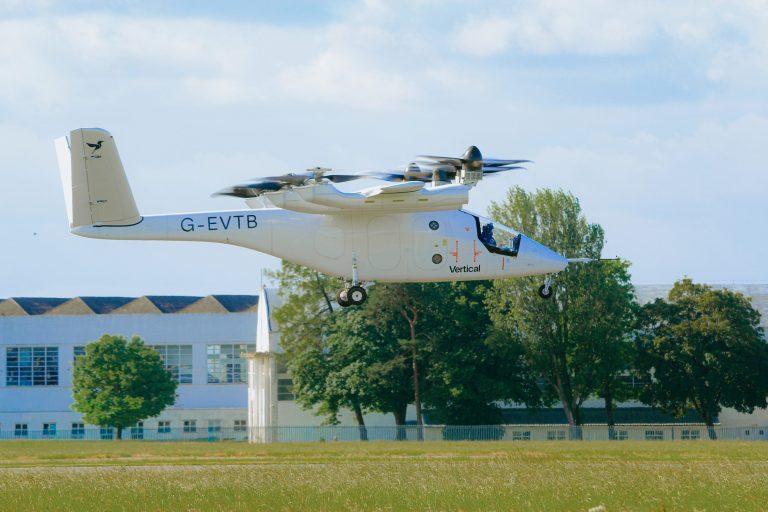
Vertical Aerospace has hit a milestone that eVTOL builders love to advertise and regulators love to interrogate: its third full-size prototype completed its first piloted flight. The British company says the aircraft lifted off on 5 June 2026 from an airfield in Gloucestershire, with test pilot Paul Stone at the controls and approval from the UK Civil Aviation Authority.
This is Vertical Aerospace’s third full-scale eVTOL prototype, and it arrives at a sensitive moment. The company says the latest flight marks a doubling of test capacity ahead of the Critical Design Review, the point at which the final configuration is locked in for certification. For a sector where cash burns faster than battery charge, that kind of momentum matters almost as much as the flight itself.
What this third eVTOL prototype changes
Vertical says the new aircraft shares the same architecture as its earlier prototypes, which already completed thrust, wingborne, and two-stage transition testing. In other words, this is not a vanity build with extra gloss; it is part of the company’s push to expand real-world validation before certification gets serious.
After the third prototype finishes the same test campaign, Vertical plans to convert it into a hybrid-electric version. The aim is straightforward: more range, more payload, and a configuration that could suit defense, logistics, and commercial aviation customers that want utility before elegance.
The certification path is getting tighter
The Critical Design Review is the next gate, and it is a big one. Once that is completed, Vertical says it will begin assembling its first pre-production aircraft. That sequence is standard in aviation, but in eVTOL it carries extra weight because rivals are still trying to prove that the category can move from slick renders to repeatable aircraft with regulators in the loop.
Competitors such as Joby Aviation, Archer Aviation, and Lilium have all spent years trying to turn flight-test footage into certification progress, and the industry has already learned that piloted flight is only one milestone among many. The harder part is scaling test data into an aircraft that can be built, approved, and sold without the whole business model wobbling.
What comes after the first pilot flight
For Vertical, the immediate win is not just airtime but more evidence. If the company can keep expanding its test fleet and close out CDR, it will enter the pre-production phase with a stronger case that the design is stable enough to manufacture. The open question is the one that matters in this sector: can the aircraft move from milestone to market without the schedule slipping into the usual aerospace time warp?