

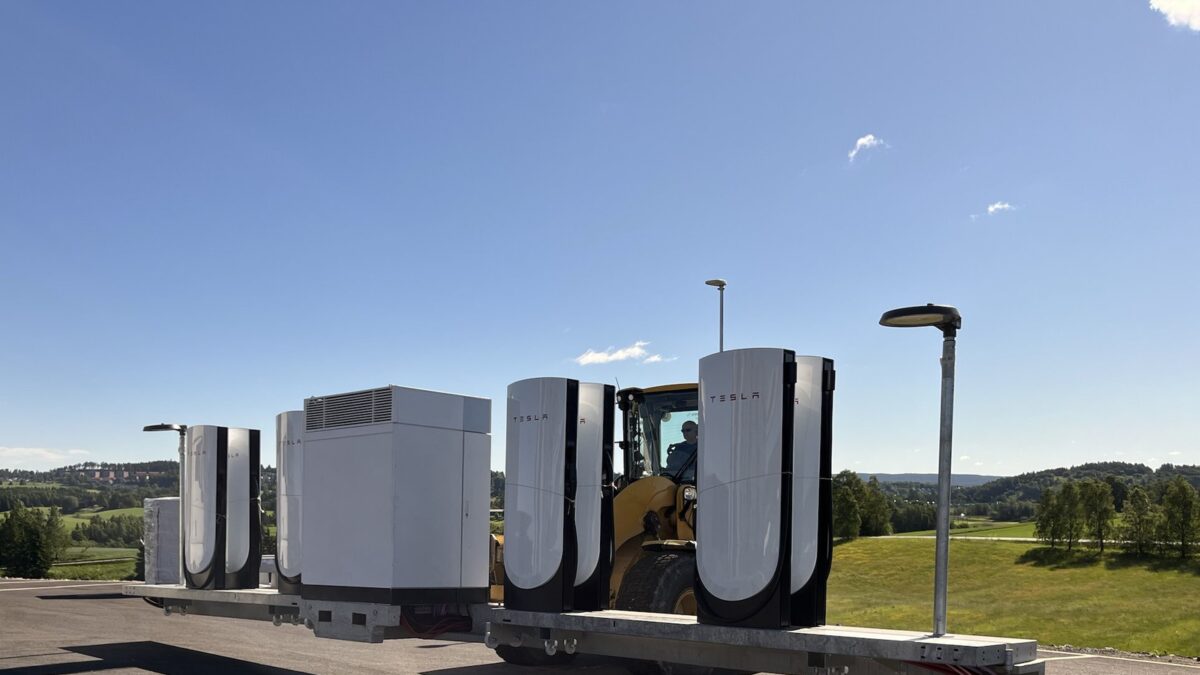
Tesla has started deploying a new kind of Supercharger V4 infrastructure in Europe, and the pitch is simple: ship it folded, unfold it on site, and get chargers live faster. The company says the modular setup cuts construction costs by about 20% and doubles installation speed, which is exactly the sort of arithmetic operators like when power demand keeps climbing and permits keep taking their sweet time.
The first units use Tesla Supercharger V4 charging modules rated at up to 500 kW, with support for as many as eight charging stalls per module. Tesla also says a single truck can deliver up to 16 stalls, a small but useful detail for scaling across multiple markets without turning every rollout into a logistics opera.
Folding Supercharger V4 stations arrive in Europe
These stations are delivered in a folded configuration and assembled on location, reducing the amount of heavy on-site work needed before a site can start serving drivers. That matters because charging networks are no longer winning by raw ambition; they are winning by how quickly they can add bays where traffic already exists.
Tesla says the new design also simplifies commissioning because it no longer requires mandatory Tesla service engineers to be present. That is a fairly direct admission that the old model was too hands-on for a network that needs to spread far beyond a few flagship corridors.
Up to 500 kW and eight stalls per module
- Charging modules: Tesla Supercharger V4
- Peak power: up to 500 kW
- Stalls per module: up to eight
- Construction cost: about 20% lower, according to Tesla
- Installation speed: doubled, according to Tesla
- Delivery density: up to 16 stalls per truck
Tesla says a refreshed version of the folding Supercharger will arrive in the second quarter of 2026, with better specs and more flexible deployment options. That sounds like the company is still tuning the concept rather than treating it as a finished product, which is hardly surprising in a charging market where everyone from automakers to oil majors is trying to move faster without building themselves into a corner.
The open question is whether the folded-and-unpacked approach becomes Tesla’s default for European expansion, or just the next iteration in a network that keeps evolving because the demand for fast charging keeps outrunning the old buildout playbook.