

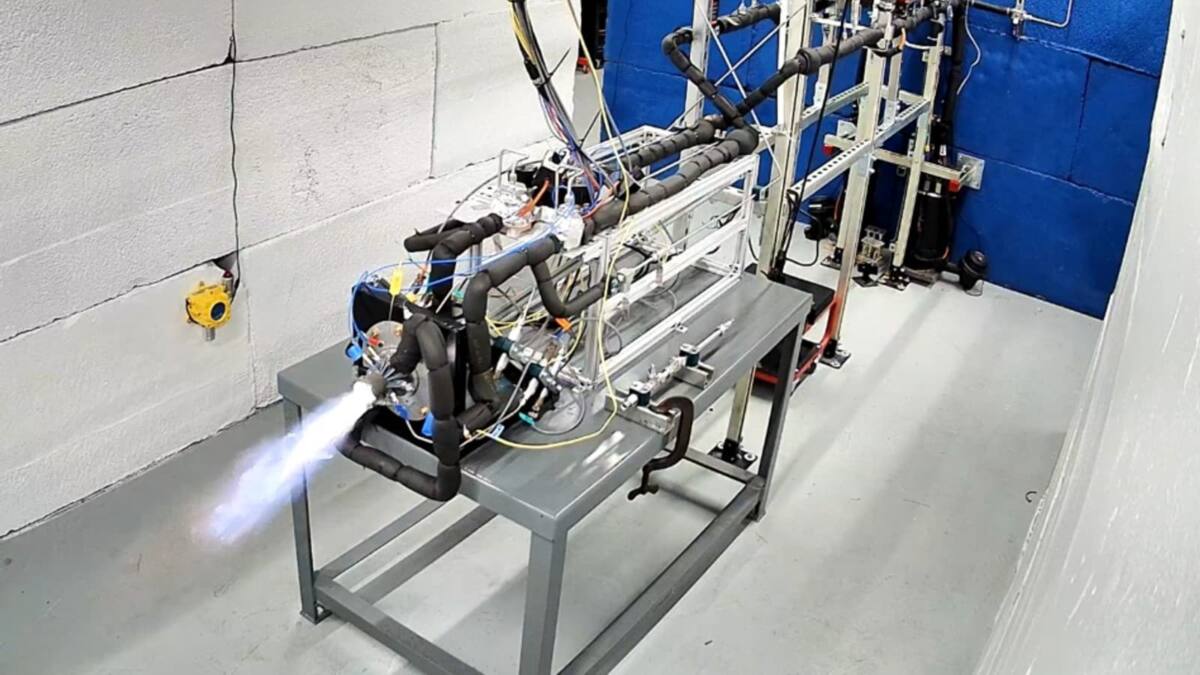
Juno Propulsion has raised $1.4 million to push a rotating detonation engine for satellites toward its first orbital test, planned for the first quarter of 2027. The company’s pitch is simple: if the hardware works in space, satellites may get a propulsion system that is more efficient, easier to handle than hydrazine-based setups, and potentially cheaper to run.
The project, called Iris, is slated to fly as a payload on Momentus’ satellite platform. A successful demo would make it the first commercial system based on a rotating detonation engine to provide in-space propulsion, a milestone for a technology that has spent years sounding more like a physics exam than a product line.
What Iris is trying to prove
Rotating detonation engines work differently from conventional rocket engines. Instead of steady combustion, they rely on a continuously spinning detonation wave, a design that theoretically squeezes more performance from the same propellant. Juno says the engine has already gone through a series of hot-fire tests after winning NASA TechLeap last summer, and those tests reportedly showed combustion efficiency about 7% higher than an ideal constant-pressure engine.
- Funding raised: $1.4 million
- First orbital test: first quarter of 2027
- Demo payload: Iris, riding on Momentus
- Propellant: nitrous oxide and ethane
Why the propellant choice matters
There is also a practical angle here, and it is not subtle. Many satellite propulsion systems still depend on hydrazine, which is toxic and cumbersome enough to make handling it a safety exercise. Juno’s engine uses nitrous oxide and ethane instead, a mix the company says is simpler to work with and cheaper.
That could matter most for small satellites, where every kilogram and every dollar count. The first flight is supposed to check whether the engine can ignite in space, sustain longer orbital-raising burns, and deliver short, precise pulses for proximity operations and servicing missions.
A crowded race toward TRL 9
Juno is not alone in chasing rotating detonation propulsion. JAXA, Venus Aerospace, and other groups are also working on similar systems, which suggests the big competition is no longer the science itself, but who can turn lab hardware into something repeatable and manufacturable. Juno says part of the new capital will go into production capacity, with a plan to build dozens of engines a year in the coming years.
The finish line is a high one: TRL 9, the level that means a system is fully validated and ready for operational use. If the 2027 demo works, the real prize will not just be performance on paper, but a propulsion option that gives small satellites a mix of efficiency, compactness, and lower operating cost that older approaches struggle to match.