

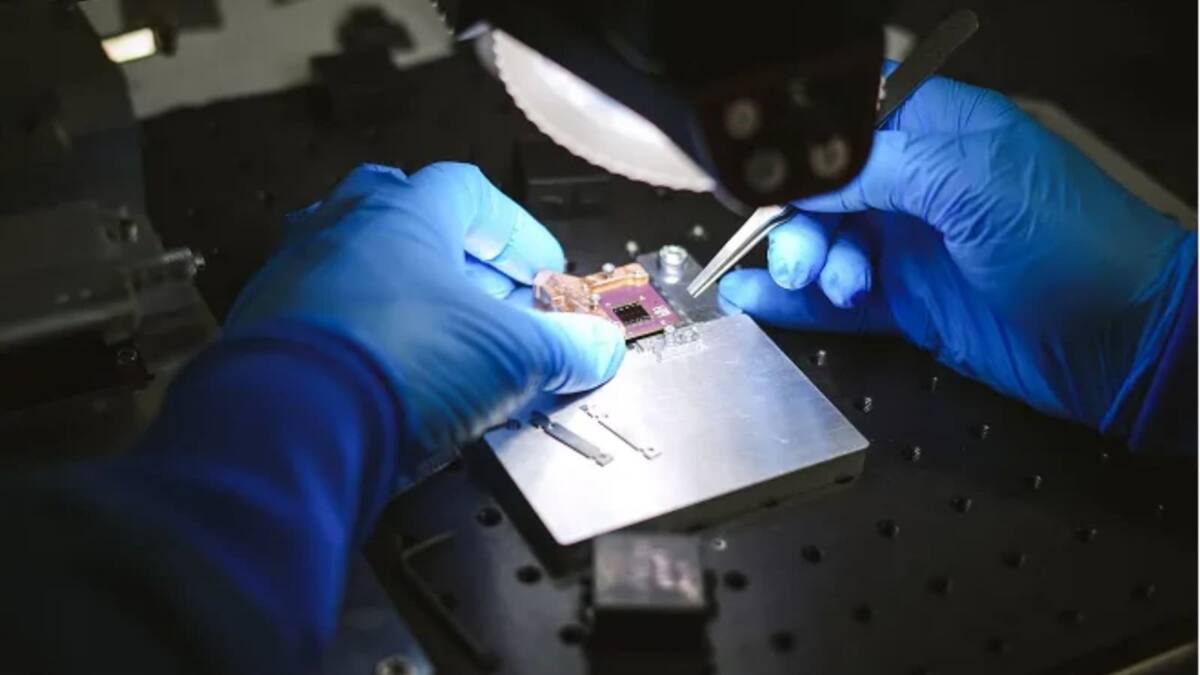
French quantum startup C12 says it has found a cleaner way to build the fragile guts of a quantum processor: test the carbon nanotubes first, then place only the good ones onto a chip. The company’s new Pick & Place process is meant to cut defects, reduce noise, and make large-scale quantum computers a lot less hypothetical.
That may sound like an industrial trick borrowed from standard chip manufacturing, and that is exactly the point. Quantum hardware has spent years tripping over the same problem – tiny material flaws that snowball into errors – so a method that improves consistency before assembly is more than a nice engineering flourish.
How C12’s Pick & Place process works
C12’s qubits are spin qubits housed inside nanotubes made from ultra-pure carbon-12. The company grows those nanotubes using its own process, checks each one electrically, and only then transfers the suitable pieces onto quantum chips. In other words: no blind assembly and no praying to the yield gods.
The logic here is straightforward. If the physical qubits are more reliable, fewer of them are needed to build a logical qubit, which is the unit that matters for fault-tolerant machines. That is the bottleneck every serious quantum program is trying to break, whether it comes from a startup in France or a much larger rival with deeper pockets.
Why carbon nanotubes are attractive for quantum hardware
Carbon nanotubes have long appealed to quantum engineers because they can provide a relatively clean, low-noise environment. They also fit better with existing semiconductor manufacturing methods than some other quantum approaches, which matters if the industry ever wants to move beyond lab demos and into repeatable production.
C12 also says the platform can support a superconducting quantum bus, a communication channel between qubits that becomes important as systems scale and error-correction schemes get more demanding. That is the sort of plumbing investors rarely get excited about until it is missing.
17 quantum devices on one chip
The company says it has already shown a high-density quantum processor with 17 quantum devices on a single chip. C12 says that experiment demonstrated not just precision, but reproducibility, which is the part that separates a promising one-off from something that might actually be manufactured.
- Technology: Pick & Place for individual carbon nanotubes
- Qubits: spin qubits inside carbon-12 nanotubes
- Demonstration: 17 quantum devices on one chip
- End goal: fewer physical qubits per logical qubit
The roadmap now depends on manufacturing discipline
All of this feeds into C12’s published roadmap, which calls for four generations of quantum processors, starting with Aïdôs in 2027 and ending with Panopeia in 2033. The company says that final platform should reach 800 logical qubits, a target that would put it squarely in the race to build machines that can do useful work rather than just impress conference audiences.
The catch is familiar: quantum computing progress is no longer just about making qubits exist, but making them identical, testable, and cheap enough to scale. C12’s move suggests the next competition may look less like pure physics and more like advanced manufacturing, which is usually where the real winners start to separate themselves.