

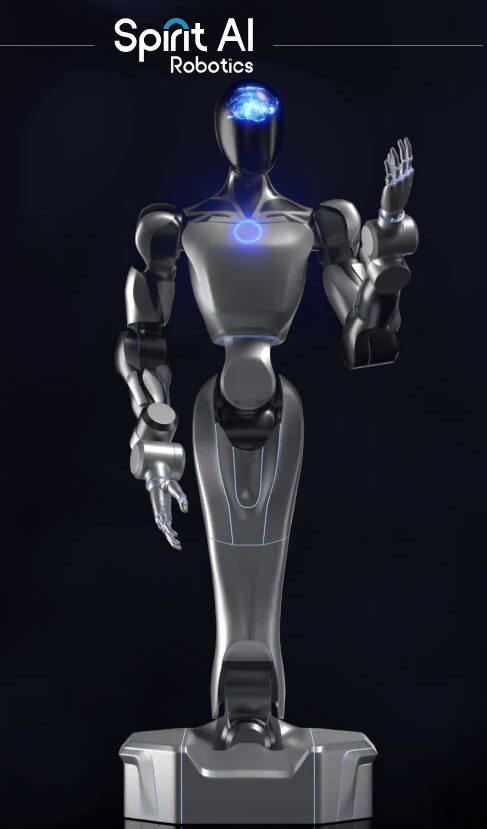
Spirit AI says its Spirit v1.6 model has taken No. 1 on the RoboArena benchmark, edging NVIDIA’s Cosmos3-Nano-Policy and another NVIDIA-backed model in a test designed to reward robots that can actually do things, not just talk about them. The Chinese startup says its physical AI model scored 1,924 points, ahead of NVIDIA’s 1,881 and DreamZero’s 1,763.
For China, the bigger milestone is that this is the first time a Chinese embodied AI model has reached the top spot on the benchmark. In a field where NVIDIA usually gets the benefit of the doubt, that is not a small result.
RoboArena is built for real-world robot skill
RoboArena is not another leaderboard for chatbot tricks. It measures how well AI systems turn decisions into physical actions, with tests that cover object manipulation, navigation, tool use, perception, planning, and adaptability in unfamiliar environments. The benchmark leans on randomized settings, adversarial scenarios, and anti-overfitting rules, which makes it much harder to game than a typical software-only test.
That matters because the next big AI market is not just search or text generation. It is the ”brains” inside humanoid robots, robotic arms, autonomous vehicles, and factory systems, where a wrong move breaks hardware instead of a sentence.
Why Spirit v1.6 is getting attention
Spirit AI’s pitch is that better model design and better training data can beat brute-force scale. According to the company, the model showed strong results in object handling, autonomous navigation, complex tool use, and adapting to new situations with minimal fine-tuning. That is the kind of efficiency story investors love, because compute is expensive and chips are not getting cheaper.
- Spirit v1.6: 1,924
- NVIDIA Cosmos3-Nano-Policy: 1,881
- DreamZero: 1,763
China is building depth across embodied AI
Spirit AI is not alone at the front of the pack. Other Chinese companies, including Manifold AI, AgiBot, and DexForce, are already leading categories tied to world modeling, robotic perception, and robotics data generation. Add rising funding to that mix – Spirit AI recently raised 1.5 billion yuan, about $222 million – and the picture gets clearer: China is not just chasing Western AI labs, it is building an ecosystem around physical AI.
NVIDIA still has huge advantages in chips, tooling, and developer mindshare, but benchmarks like RoboArena suggest the contest is widening. The real question now is whether these lab results show up in robots that can survive messy warehouses, factories, and streets without needing a PhD in prompt engineering.