

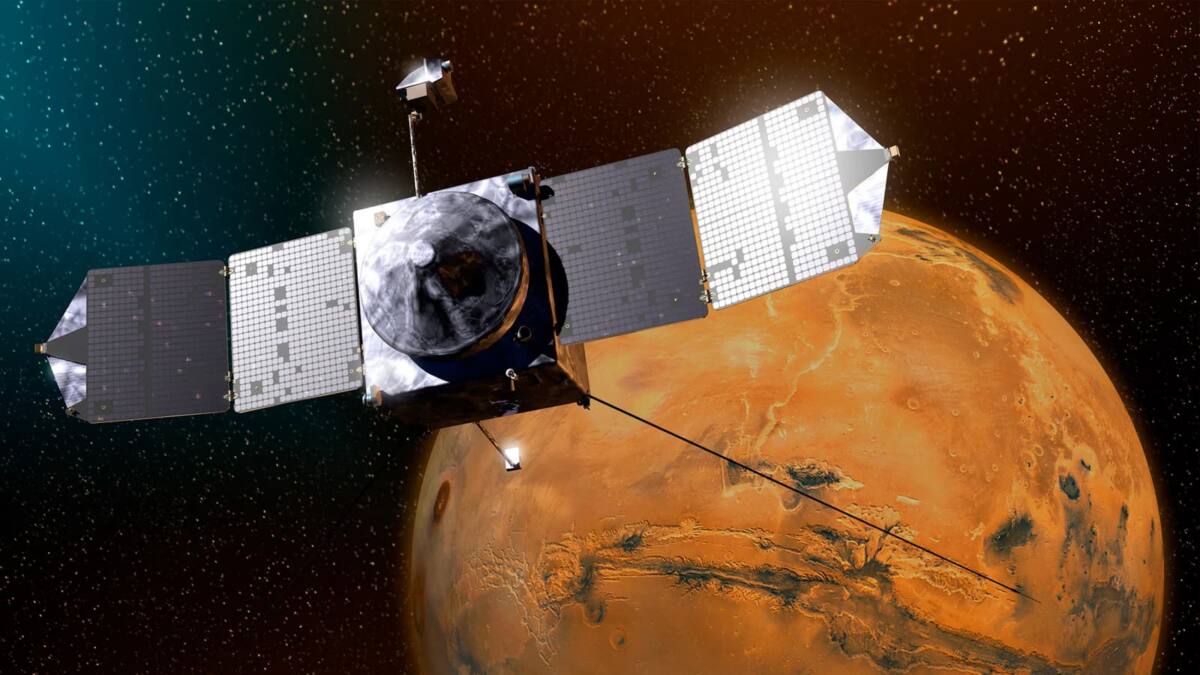
NASA has formally retired MAVEN, the Mars orbiter that spent far longer than planned unraveling the red planet’s atmosphere and quietly helping keep rovers connected to Earth. The spacecraft went dark after a failed recovery effort, ending an 11-year run that turned a one-year mission into one of the agency’s most productive Mars programs.
That is more than a sentimental goodbye. MAVEN was both a science probe and a communications relay, so its disappearance tightens an already thin network around Mars and leaves NASA leaning harder on older spacecraft and European partners to move data home.
How MAVEN went silent
The last good contact came on 6 December, just before the solar-powered orbiter slipped behind the far side of Mars. When it was supposed to reappear, telemetry pointed to a safe-mode event and uncontrolled spinning, which drained the spacecraft’s remaining power. A NASA review panel confirmed that sequence in February, although the exact trigger is still being investigated.
That kind of failure is the sort of thing mission teams dread because it usually gives you just enough information to know the end is coming, not enough to stop it. NASA kept trying for months anyway, which is standard procedure when a veteran spacecraft is only half dead.
A one-year mission that lasted 11 years
MAVEN launched on an Atlas V in November 2013 and reached Mars about 10 months later. It was originally built for a single Earth year of operations, but the spacecraft’s systems held up so well that NASA extended the mission again and again until it became an 11-year science workhorse.
That long service life is part of a familiar Mars pattern: NASA routinely gets far more mileage from its orbiters than the sticker plan suggests. Mars Odyssey, launched in 2001, and the Mars Reconnaissance Orbiter, launched in 2005, are still working too, and both have already outlived their original guarantees by a wide margin.
What NASA loses at Mars
With MAVEN gone, NASA’s active Mars fleet shrinks to just two orbiters. That matters because these spacecraft are not just doing science; they also act as relay towers for rovers on the surface, where direct communication with Earth would be painfully inefficient. Five orbiters had been sharing that job, and now only four remain.
- NASA relays now: Mars Odyssey, Mars Reconnaissance Orbiter, Mars Express, and Trace Gas Orbiter
- NASA Mars orbiters still operating: 2
- Mars relay spacecraft before MAVEN’s loss: 5
The bigger issue is that MAVEN was never just another bus in orbit. It carried instruments designed specifically to study how Mars lost much of its atmosphere to the solar wind, and that work helped reshape planetary science far beyond one mission. Louise Prockter, who leads NASA’s planetary science division, said the dataset will keep producing useful results for decades, which is what agencies say when a mission dies but the papers keep coming.
The science will outlive the spacecraft
That part is hard to argue with. MAVEN’s archive is already rich enough to fuel future studies of atmospheric escape, space weather, and Mars climate history, while newer missions can still build on what it measured from orbit. The real question now is whether NASA can keep Mars communications stable long enough to bridge the gap to whatever comes next.