

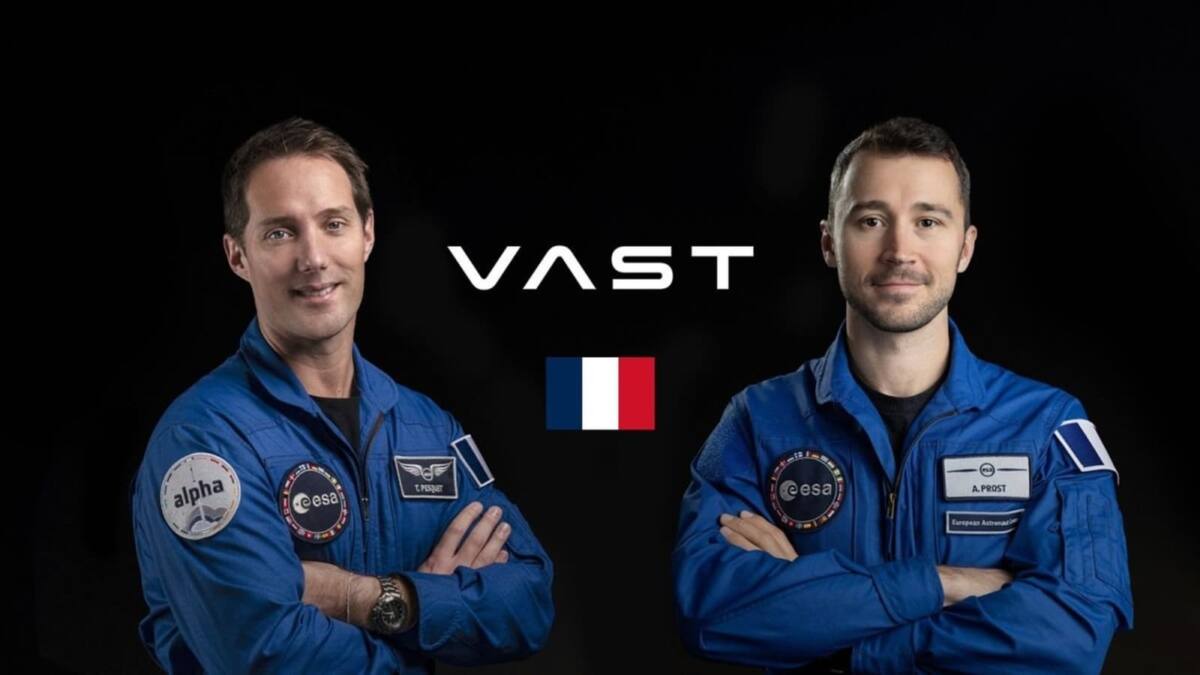
France is sending two astronauts on future missions in 2027, including the first crewed flight to Vast’s Haven-1 commercial space station. One seat is tied to the International Space Station, the other to Vast’s debut outpost, and both flights will use SpaceX Crew Dragon for missions expected to last about two weeks.
The agreement gives Vast a major European partner at a time when commercial stations are still more promise than hardware, and it gives France a way to keep astronaut flight experience flowing as the ISS era slowly winds down.
Thomas Pesquet and Arnaud Prost get the seats
For the ISS mission, ESA astronaut Thomas Pesquet is the expected pick and would serve as commander, helped by NASA rule changes that now allow seasoned astronauts from Europe, Canada, and Japan to lead private missions. Pesquet has already logged two long flights to the station, in 2016 and 2021, so this is less a gamble than a familiar face being handed the controls again.
The Haven-1 flight is slated for Arnaud Prost, an ESA reserve astronaut from the 2022 class. Reserve astronauts are increasingly becoming a useful bridge between national space agencies and the commercial sector, a path Axiom Space has already used to put non-traditional crew members into orbit without requiring a full-time agency slot.
What Vast gets from France
Vast says the agreement reinforces its plan to build the first commercial orbital station and underscores France as a key international partner. That is smart positioning: in the private-station race, credibility matters almost as much as propulsion, and visible government backing beats another glossy render every time.
The company also said it intends to place its European headquarters in Paris. That fits neatly with the politics of the announcement, which came during the Choose France summit hosted by Emmanuel Macron to attract foreign investment.
- Two French astronauts are planned for 2027 missions
- One mission goes to the ISS, one to Haven-1
- Both flights will use SpaceX Crew Dragon
- Each mission is expected to last about two weeks
The rise of the sovereign astronaut
The broader trend here is obvious enough: governments do not want to lose human spaceflight capability just because the station they’re using is privately owned. France is treating commercial stations as an extension of national space policy, not a substitute for it, and that model will look increasingly attractive to other spacefaring countries with smaller budgets.
Vast said the crews will also support scientific experiments, technology demos, and educational work with French companies and research groups. France plans to reveal more at the International Space Summit in Paris in September, and the open question now is whether this is the start of a wider European buying spree for private orbital access, or just the first very polished example.