

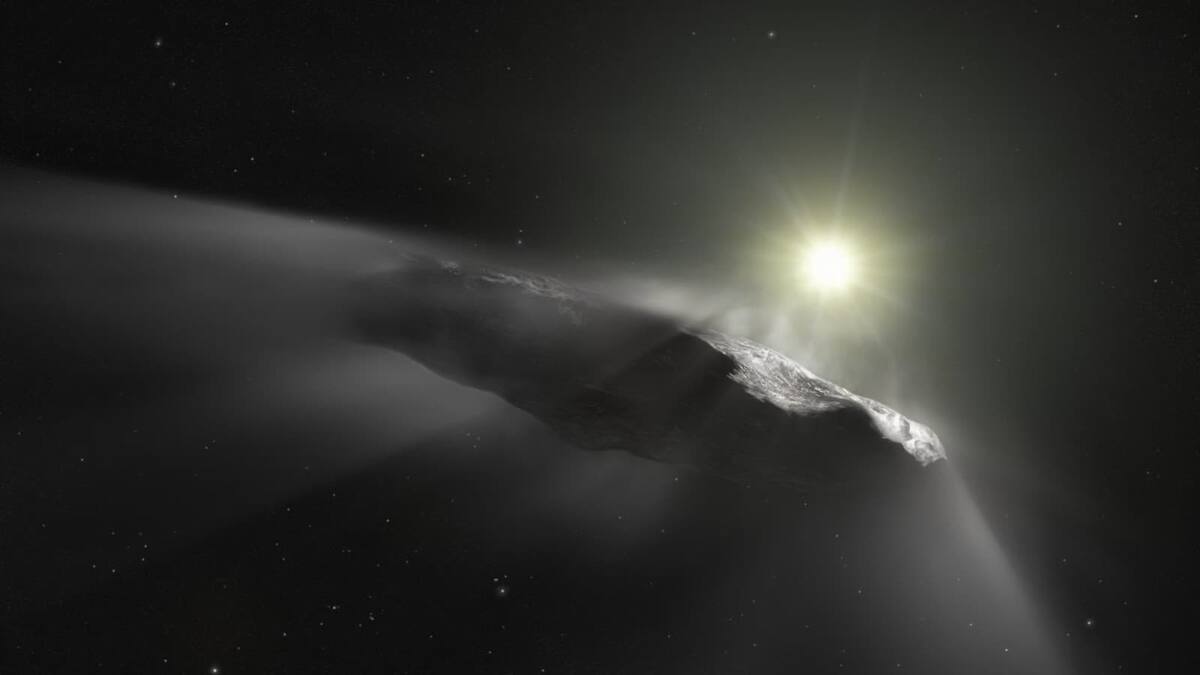
A new preprint suggests that some of the Milky Way’s missing mass may not be dark matter at all, but a swarm of interstellar comets and asteroids drifting between stars. The claim is bold, the evidence is thin, and the real story is less ”dark matter is solved” than ”astronomers may have been undercounting the junk between systems for years.”
The paper argues that these interstellar objects, or ISOs, could account for 13% to 45% of the mass usually attributed to dark matter in the Milky Way. That is still a long way from replacing the standard model, but it is enough to matter for how scientists interpret the Milky Way’s rotation curve and the invisible matter inferred from it.
How the interstellar comets model works
Researchers used a statistical model based on the Poisson distribution to estimate how dense this population might be near the Solar System. Their scenario leans on extrapolating from 3I/ATLAS, described in the source work as the largest known object of its kind, and treats it as a proxy for a much larger unseen population.
That is an aggressive assumption, but not a random one. Astronomers have already logged a tiny cast of interstellar visitors – 1I/’Oumuamua, 2I/Borisov, and 3I/ATLAS – and history says the first few detections of any rare class usually tell you more about the limits of your telescope than the full size of the population.
Why dark-matter experiments could feel the ripple
If the ISO hypothesis holds even partly, it does not erase dark matter searches. It does, however, tweak the baseline density used by direct-detection experiments such as LZ and XENONnT, which assume a local dark-matter density when estimating how many WIMPs should pass through their detectors.
- Potential contribution from interstellar objects: 13% to 45% of the ”missing mass” usually blamed on dark matter
- Named interstellar objects referenced in the model: 1I/’Oumuamua, 2I/Borisov, and 3I/ATLAS
- Experiments that could need revisiting: LZ and XENONnT
That kind of adjustment would not be small. Even a reduction of a few tens of percent in the assumed local density would force a rethink of how sensitive those detectors really are, which is awkward for a field that already lives on the edge of statistical patience.
The sample size is still very small
The catch is obvious: the model rests on a very small observational sample, with 3I/ATLAS doing a lot of the heavy lifting. That makes the upper estimates highly sensitive to assumptions about object size, frequency, and distribution, so the numbers are best read as a testable proposal rather than a fresh cosmological truth.
New sky surveys over the next few years should bring more interstellar objects into view, which is exactly what this debate needs. If the tally rises quickly, the ISO idea gets stronger; if not, dark matter keeps its crown and the comets go back to being an interesting footnote in the Galaxy’s accounting books.