

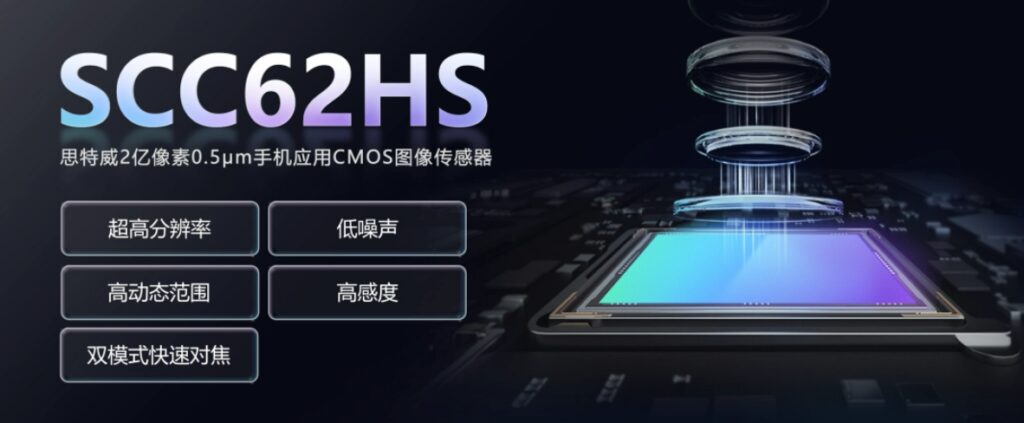
SmartSens has stepped into the 200MP smartphone sensor race with the SCC62HS, a new mobile image sensor built on its domestic Stacked BSI platform and already in sampling. The SmartSens SCC62HS is aimed at high-end handset cameras, with mass production expected to begin in Q3 2026. The pitch is familiar – more resolution, better low-light capture, smarter HDR – but the company is also trying to make the economics work, which is the part that usually decides whether these sensors end up in phones people actually buy.
The SCC62HS uses a 55nm Stacked BSI process, 0.5μm pixels, and a 1/1.55-inch optical format. SmartSens says that setup is meant to hold onto fine detail without pushing manufacturing costs into the stratosphere, a balancing act every sensor maker now seems to claim as resolution climbs.
SCC62HS specs and imaging features
On paper, the sensor is packed with the usual premium-camera acronyms, plus a few useful ones. SmartSens says the SCC62HS supports PixGain HDR, SFCPixel, and AllPix ADAF, with output up to 200 megapixels and a focus on cleaner images across bright and dark scenes.
- Resolution: 200 megapixels
- Process: 55nm Stacked BSI
- Pixel size: 0.5μm
- Optical format: 1/1.55-inch
- Dynamic range: up to 86.3dB with PixGain HDR
- Sensitivity: 3574mV/lux*s
- Read noise: as low as 0.92e-
The HDR side matters more than the megapixel number. SmartSens says on-chip dual-frame fusion reduces the load on the handset chipset during HDR video recording, which should also help power consumption. That is the sort of feature phone makers love to quote in launch slides, because it sounds fancy and solves an actual engineering problem.
Autofocus and low-light performance
For focusing, the SCC62HS supports both AllPix ADAF and Sparse PDAF. SmartSens says full-pixel focusing is better for difficult lighting, while the partial phase-detection approach is meant to trim power use during normal operation. In other words, it is trying to cover both the glossy marketing demo and the battery-life complaint that follows it.
SmartSens also claims a low-light sensitivity of 3574mV/lux*s, along with the 0.92e- read noise figure, to keep detail intact in darker scenes. That puts the sensor squarely in the same arms race as rivals from Sony, Samsung, and OmniVision, where the fight is no longer just about piling on pixels but about doing something useful with them.
Mass production is set for Q3 2026
SmartSens has already started sampling the SCC62HS to partners, with mass production expected to begin in the third quarter of 2026. If the company lands design wins, the sensor could give Chinese handset brands another 200MP option at a time when camera hardware differentiation is getting harder, not easier.
The real test will be whether the SCC62HS shows up in shipping phones, not just in spec sheets. In a market where 200MP sensors are becoming more common, the winners are usually the parts that combine decent image quality, reasonable power draw, and a price OEMs can tolerate without grimacing.