

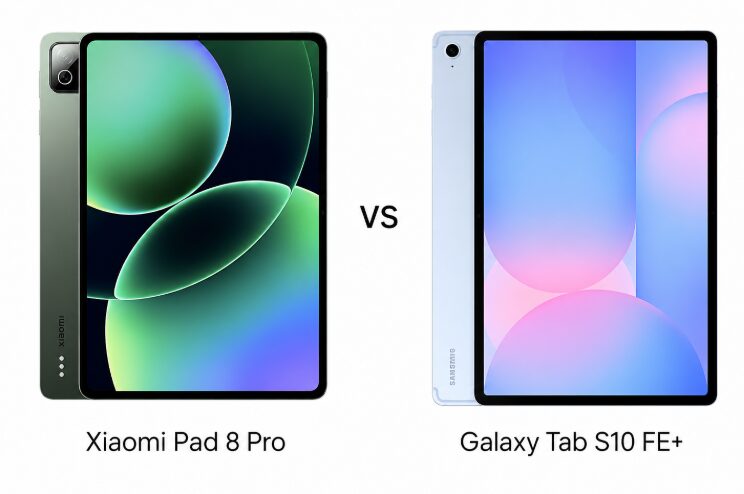
Xiaomi is pushing a simple argument with the Pad 8 Pro: if you want the faster, sharper, more entertaining tablet, why pay more for Samsung? On paper, the answer tilts toward Xiaomi, while the Galaxy Tab S10 FE+ leans on size, durability, and Samsung’s polished software stack to justify its higher price.
The Xiaomi Pad 8 Pro undercuts the Galaxy Tab S10 FE+ on price in China, with a starting figure of about $500 versus roughly $700 for Samsung’s tablet. Xiaomi also pairs that lower price with flagship silicon, a 144Hz panel, and 67W charging, which makes the value case hard to ignore.
That split is familiar in tablets. Apple sells the ecosystem premium, Samsung often sells the productivity premium, and everyone else tries to undercut both without looking cheap. Xiaomi’s pitch here is more aggressive than usual: flagship silicon, a 144Hz panel, and 67W charging at a price that undercuts Samsung by a wide margin.
Xiaomi Pad 8 Pro vs Galaxy Tab S10 FE+ display and portability
The Pad 8 Pro uses an 11.2-inch display inside a slim 5.8mm aluminum body that weighs under 500g, so it sounds far easier to live with in one hand or on a commute. Samsung goes the other way with a 13.1-inch screen and a weight above 660g, which is the sort of thing that makes a tablet feel more like a portable desk.
Xiaomi also stacks the panel spec sheet in its favor: 144Hz refresh rate, Dolby Vision, HDR10, and up to 800 nits brightness. Samsung’s 90Hz panel is bigger and better for split-screen work, but it does not look nearly as tailored for gaming, streaming, or the usual ”I bought this for media and now I am using it for everything” routine.
- Xiaomi Pad 8 Pro: 11.2-inch IPS display, 144Hz, Dolby Vision, HDR10, up to 800 nits
- Galaxy Tab S10 FE+: 13.1-inch display, 90Hz, larger canvas for multitasking
- Xiaomi Pad 8 Pro: under 500g and 5.8mm thick
- Galaxy Tab S10 FE+: over 660g, but IP68 water and dust resistance
Snapdragon 8 Elite versus Exynos 1580
This is where the contest stops being polite. Xiaomi uses the Snapdragon 8 Elite, built on a 3nm process and paired with the Adreno 830 GPU, so it is operating in flagship smartphone territory rather than tablet compromise land. Samsung’s Exynos 1580 is described as upper-midrange, which is fine for everyday use but not the kind of chip that scares a benchmark chart.
That matters because Android tablets still live or die by how well they handle heavy multitasking and the occasional burst of ambition, whether that means creative apps or a game that actually asks something of the hardware. Samsung’s One UI remains the more mature large-screen interface, though, and that software polish plus the microSD slot gives the Tab S10 FE+ a practical edge for people who need a working machine, not just a fast one.
Battery, charging, and accessories
The battery numbers are close enough to avoid an easy win. Samsung packs a 10,090mAh battery, while Xiaomi uses a 9,200mAh cell, and the real-world gap may narrow because Samsung’s 90Hz panel is less demanding than Xiaomi’s 144Hz display.
Charging is less of a debate: Xiaomi’s 67W wired charging should cut downtime sharply, while Samsung stays at 45W. Xiaomi also adds reverse wired charging, which is the sort of extra that sounds small until you need it, and suddenly it feels very smart indeed.
Both tablets support styluses, but Samsung still owns the cleaner accessory story. The S Pen experience has had years of refinement, and Galaxy ecosystem integration remains one of Samsung’s strongest selling points. Xiaomi is improving under HyperOS, but it is still chasing maturity rather than setting it.
Cameras and media extras
Tablet cameras are usually there because manufacturers had nowhere else to put them, but Xiaomi still gives you better hardware. The Pad 8 Pro uses a 50MP rear camera and a 32MP ultrawide front camera, while Samsung settles for a 13MP rear sensor and a 12MP ultrawide selfie camera.
Both can record 4K video from the rear, and Samsung also allows 4K capture from the front camera. Even so, Xiaomi looks better equipped for video calls, document scanning, and entertainment thanks to Dolby Atmos-tuned quad speakers, Dolby Vision support, and Hi-Res audio certification.
Xiaomi Pad 8 Pro price vs Galaxy Tab S10 FE+ price
Xiaomi lists the Pad 8 Pro at approximately $500 (₹47,000), while Samsung puts the Galaxy Tab S10 FE+ at around $700 (₹48,500). The difference is oddly small in Indian pricing estimates, which makes Samsung’s premium feel harder to defend unless you care deeply about IP68 protection, expandable storage, or the bigger display.
That leaves the cleanest takeaway for buyers: Xiaomi is the better hardware bargain, Samsung is the safer productivity bet. The Pad 8 Pro should be the one to watch if Xiaomi can keep pricing disciplined outside China, because a fast chip, fast charging, and a high-refresh display are exactly the sort of specs that make a mid-premium tablet look expensive in all the wrong ways.