

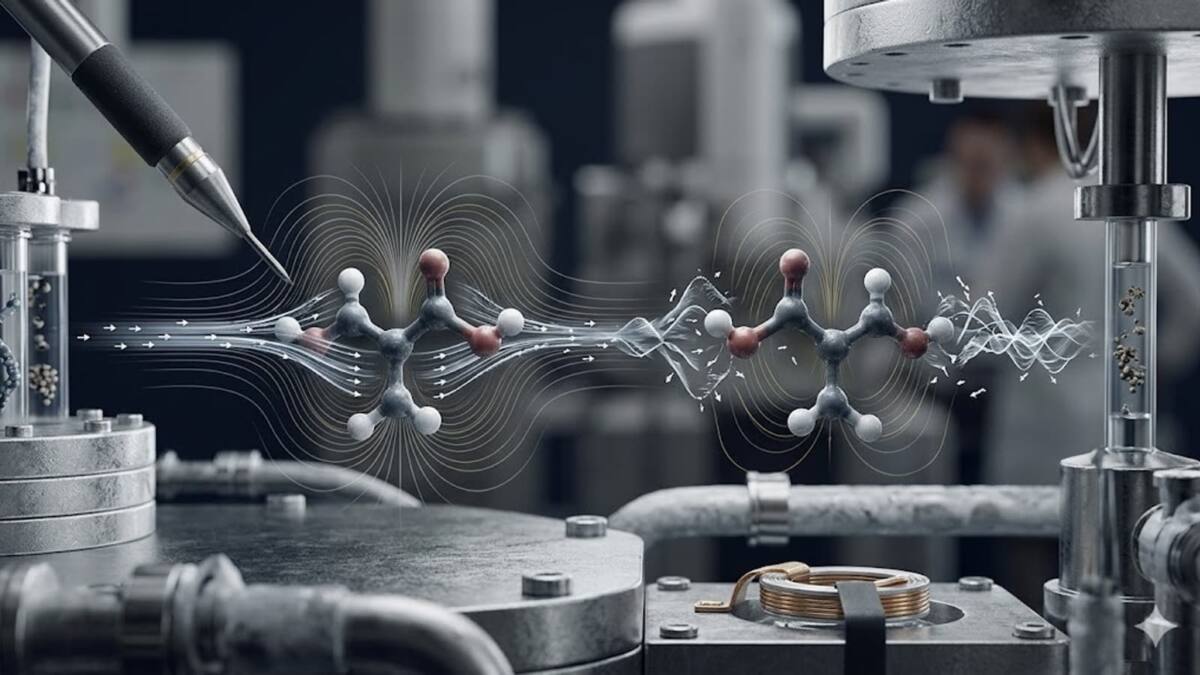
Life’s chemical ”handedness” may have a surprisingly physical origin. A new study on electron spin and life’s homochirality, led by Yossi Paltiel of the Hebrew University of Jerusalem and Ron Naaman of the Weizmann Institute, suggests that electrons, not just chemistry, could have helped lock biology into using one mirror form of a molecule over the other.
The puzzle is old and awkward: many molecules exist in two mirror-image versions, or enantiomers, but living systems overwhelmingly choose one. Amino acids and sugars do not just split the difference and move on, which is exactly why homochirality has bothered biologists and chemists for decades. The new work points to a mechanism where electron spin creates small but persistent differences in how those mirror forms behave over time.
How electron spin breaks the tie
The core idea is simple enough to be annoying: when an electron passes through a chiral molecule, its spin interacts differently with each mirror form. The molecules may have the same energy, but their dynamics are not the same, which means electron transport and interactions with magnetic surroundings can diverge in ways chemistry alone would miss.
That difference is tiny, but the study reports that it is measurable. Over long stretches of time, a slight edge can compound into a very large one, which is exactly how a microscopic bias becomes a macroscopic rule.
What the experiments and calculations showed
The team combined theoretical calculations with experiments to test the spin-dependent effect. The takeaway is not that one mirror form is magically lower in energy, but that it can gain a practical advantage in dynamic processes. That is a more interesting claim than the usual ”chemistry did it” explanation, and a more plausible one for a system that had plenty of time to settle into an uneven result.
- Two mirror forms can look identical in static chemistry.
- Electron spin can make their behavior diverge during transport and magnetic interactions.
- Small dynamic differences can accumulate into biological dominance.
Why origin-of-life researchers will care
This matters because the origin of homochirality has always been a search for the first nudge. Past theories leaned heavily on chemistry, surfaces, or chance amplification. The new result adds a physical mechanism that could work alongside those ideas, which is a reminder that life may have inherited its preferences from the awkward interaction between molecules and electrons.
If that sounds like a narrow effect, it is. But narrow effects win big when they are repeated enough times. That is also why researchers keep finding that biology is less a clean break from physics than a very persistent negotiation with it.
The next question for homochirality research
The obvious next step is to test how widely this spin-based mechanism applies across different molecules and environments. If it holds up, the story of life’s ”right-handed” and ”left-handed” chemistry may need a more physical footnote than anyone expected.