

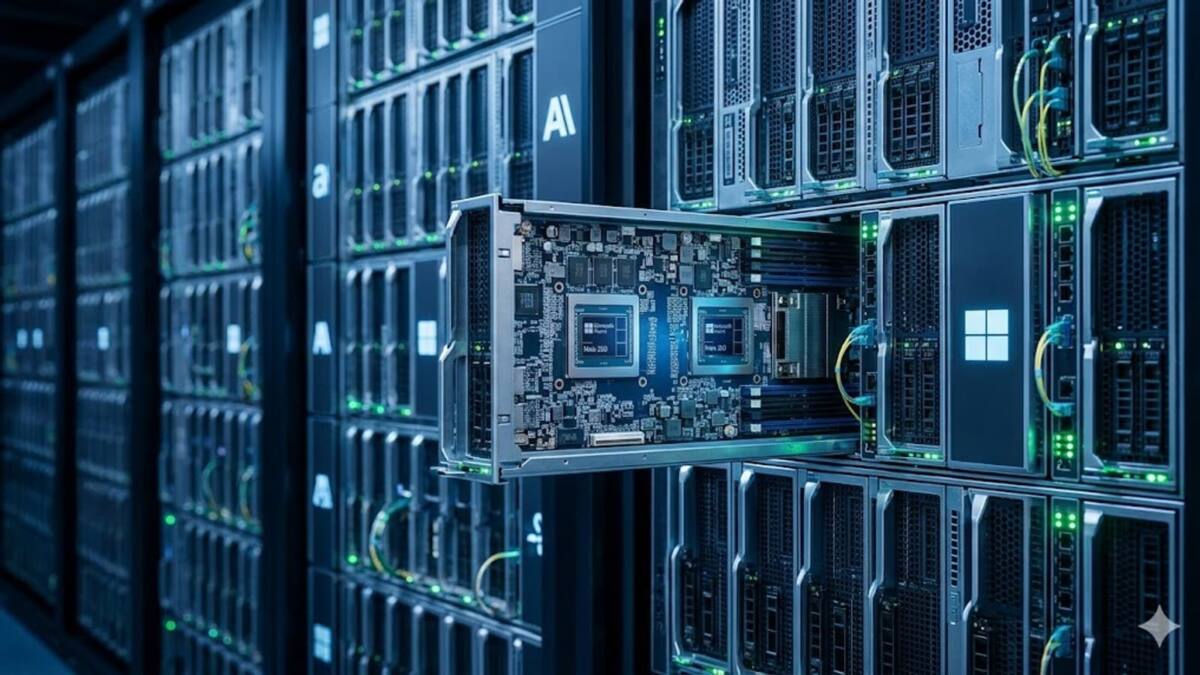
Anthropic is reportedly in talks to use Microsoft’s Maia chips for model training and inference, a move that would give the AI lab another way to buy more compute without leaning so heavily on the cloud giants it already depends on. The potential target is Maia 200, Microsoft’s newest in-house accelerator, which the company says is already running in its own data centers.
Anthropic has been on a spending spree to secure compute for larger models, and the arms race has become less about bragging rights and more about who can keep the lights on at scale. If Microsoft can offer a chip that is both available and competitive, that gives Anthropic another lever on cost, capacity, and bargaining power.
What Maia 200 brings to the table
Microsoft pitches Maia 200 as a serious piece of silicon: built on TSMC’s 3-nm process, with up to 10 petaflops of FP4 performance, 5 petaflops of FP8, 216 GB of HBM3e memory, and 7 Tb/s of bandwidth. Microsoft also says it outperforms comparable offerings from Amazon’s Trainium and Google’s TPU.
- TSMC 3-nm process
- Up to 10 petaflops FP4
- 5 petaflops FP8
- 216 GB HBM3e memory
- 7 Tb/s bandwidth
Anthropic keeps adding chips, clouds, and suppliers
This would fit a broader pattern. Anthropic already rents data center capacity from SpaceX, has signed major agreements with Akamai, and is also considering inference chips from the British startup Fractile. It uses Google Cloud as well, and has an agreement for more than 1 million TPU chips for model training.
The company’s hardware mix is already unusually wide, and that is the point. By spreading workloads across Microsoft, Google, Amazon, and smaller specialists, Anthropic reduces the risk of being boxed in by any single supplier – or by the friendly little habit cloud vendors have of charging more once they know you cannot leave.
Microsoft, Amazon, and Google all have stakes in the race
Anthropic’s relationship with Microsoft dates back to 2025, when it bought $30 billion in Azure compute and Microsoft put $5 billion into the lab. Amazon remains one of its biggest backers too, with $8 billion invested and access to Trainium2 chips through the Rainier project. The result is a strange but increasingly normal arrangement: rivals funding the same AI company while competing to sell the hardware beneath it.
Anthropic has said it plans to spend up to $11 billion on AI infrastructure. If Maia 200 becomes part of that stack, it would be less a dramatic switch than another bet that custom silicon is where the real margin fight is headed. The open question is whether Microsoft can turn Maia into a real external business, or whether Anthropic simply uses it as leverage while continuing to shop around.