

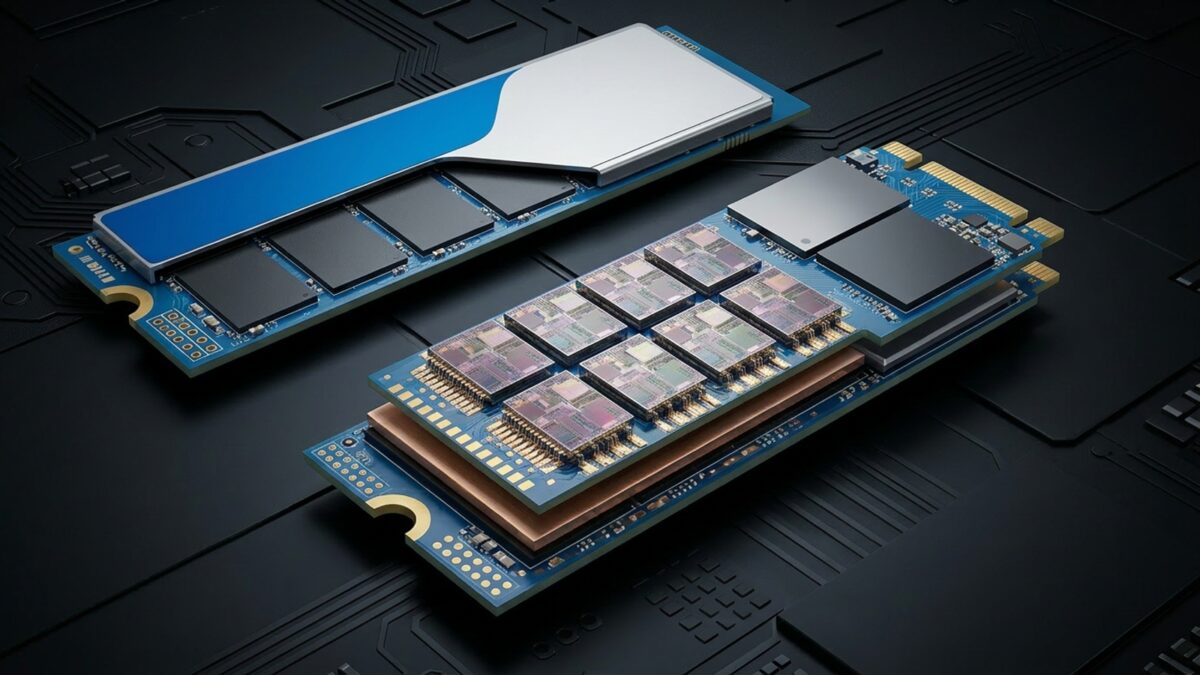
Huawei has pulled off an eye-catching storage stunt under sanctions: it has launched OceanDisk 1800 SSDs for AI infrastructure and data centers with capacities of 61.44 TB and 122.88 TB, and it is already talking about a 245 TB version. The headline number is huge, but the more interesting part is how the company got there without the usual supply chain playbook.
The new Huawei SSD drives arrive in a market where hyperscale operators are stuffing racks with far more data than traditional enterprise SSDs were designed to handle. As AI workloads keep growing, vendors are racing to cram in more capacity without making drives absurdly expensive or thermally impossible to cool. Huawei’s answer is a little less glamorous than marketing decks would like, but a lot more practical.
Huawei SSD uses die-on-board instead of traditional packaging
Instead of using conventional BGA or TSOP packaging, Huawei uses die-on-board, or DoB, which places NAND dies directly on the SSD’s printed circuit board. That approach lets the company fit more memory chips without a vertical stack, easing one of the biggest constraints on ultra-high-capacity SSD design. It also cuts out some expensive packaging steps, which is a nice bonus when your supply options are already limited.
There is a catch, of course: putting bare dies on a board makes thermal management and signal integrity much harder. Those are the kinds of engineering problems that usually separate a clever demo from a product you can actually ship. Huawei appears to have solved them well enough to bring OceanDisk 1800 to market, which is the real story here.
Why Huawei had to engineer around NAND supply limits
Huawei has been on the U.S. Commerce Department’s restriction list since 2019, cutting it off from American equipment, software, and technologies built with U.S. involvement. That has made sourcing advanced 3D NAND especially awkward. Even Samsung and SK hynix, both far ahead on layer counts, rely on U.S. technology and cannot simply sell those parts to Huawei.
Huawei’s fallback was YMTC and its Xtacking 4.0 3D NAND, but that line tops out at 232 layers, leaving Huawei behind the densest flash available from global rivals. In enterprise storage, that gap matters because more layers usually mean better capacity per footprint and a better shot at competing on cost. So Huawei did what blocked-off companies often do: it redesigned the product instead of waiting for the supply chain to rescue it.
- OceanDisk 1800 capacities: 61.44 TB and 122.88 TB
- Promised future variant: 245 TB
- Packaging method: die-on-board (DoB)
- Target use: AI infrastructure and modern data centers
What this says about the AI storage race
Huawei is not alone in chasing bigger enterprise drives, but sanctions have forced it into a stranger and arguably more inventive route than most rivals. Western vendors can lean on broad supplier ecosystems; Huawei has to squeeze more from the board itself. That pressure often produces ugly engineering and, occasionally, very interesting products.
If the 245 TB version ships, it would push the company even deeper into a niche where capacity, cost, and packaging tricks matter as much as raw NAND progress. For now, OceanDisk 1800 looks like a reminder that export controls can slow a company down, but they do not always stop it from finding another path.