

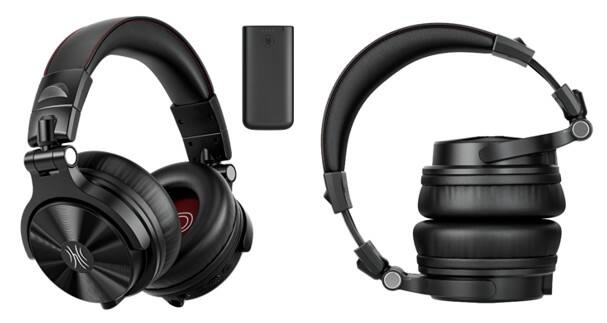
OneOdio has launched the Studio Max 2 Wireless DJ Headphones, pitching them at DJs, producers, streamers, and gamers who want near-instant wireless monitoring without giving up battery life or high-resolution audio. The headline number is 9 ms latency with the included M2 transmitter, and the company is also selling a limited KSHMR edition for collectors who prefer their gear with a signature card attached. The Studio Max 2 starts at $189.99/£179.99/€186.80.
That combination is smartly targeted. Wireless headphones for creative work usually force a compromise between convenience and timing accuracy, but OneOdio is leaning hard into both, with pricing that undercuts many established pro-audio rivals. The bigger question is whether buyers will trust a brand better known for value gear to deliver in environments where timing errors are instantly audible.
Studio Max 2 specs and connectivity
The Studio Max 2 uses OneOdio’s 3rd Generation RapidWill+ Ultra-Low Latency 3.0 technology and an upgraded 400 kbps wireless bitrate, up from 160 kbps on the previous Studio Max 1. OneOdio says that pairing with the M2 transmitter keeps timing tight while preserving lossless 2.4G transmission quality.
- 9 ms ultra-low latency
- 400 kbps wireless bitrate
- Four connectivity modes: 3.5 mm, 6.35 mm, M2 transmitter wireless, and Bluetooth 6.0
- LDAC support plus dual Hi-Res Audio and Hi-Res Wireless certifications
- Bluetooth gaming mode for lower delay
There is also a 45 mm dynamic driver with a studio-grade magnet, a 20 Hz to 40 kHz frequency range, 34 Ω impedance, 98 dB ± 3 dB sensitivity and 118 dB maximum sound pressure level. That is a respectable spec sheet for a wireless pair, even if the usual marketing caveat applies: numbers help, but tuning still decides whether the thing sounds sharp or merely loud.
Battery life and comfort for long sessions
OneOdio says the headphones last up to 120 hours on a charge, while the M2 transmitter runs for up to 50 hours. USB-C charging takes 2.5 hours or less, and the battery inside is a 1000 mAh lithium-ion polymer unit.
That endurance matters more than it sounds. Competitors in the wireless studio space have spent years trying to make latency tolerable, but marathon battery life is the quieter advantage because it reduces one more thing to manage during multi-day sessions, travel, or long sets.
The design leans on comfort too, with contoured earcups and cushioning aimed at reducing pressure during long sessions. For DJs and engineers, that is the sort of unglamorous detail that ends up deciding whether a headset gets used daily or tossed into a drawer.
KSHMR limited edition and app features
OneOdio is also releasing a Studio Max 2 Limited Signed Edition developed with DJ and producer KSHMR. Only 1,000 units will be sold worldwide, and the company says the edition adds acoustic tuning shaped by his workflow while keeping the same 9 ms latency, Hi-Res support, LDAC compatibility, and 120-hour battery life.
The companion app adds EQ adjustments, sound presets, connection-mode controls, and Find My Headphones. That makes the Studio Max 2 feel less like a single-purpose DJ headset and more like an all-round wireless tool, which is where the category is heading anyway: one pair for the booth, the desk, and the commute if the tuning holds up.
The Studio Max 2 is priced at $189.99/£179.99/€186.80, with a 15% discount available using code STUDIOMAX2PR until August 11. If OneOdio’s latency claims translate cleanly outside the demo room, this could pressure better-known audio brands to sharpen their own wireless offerings faster than they planned.