

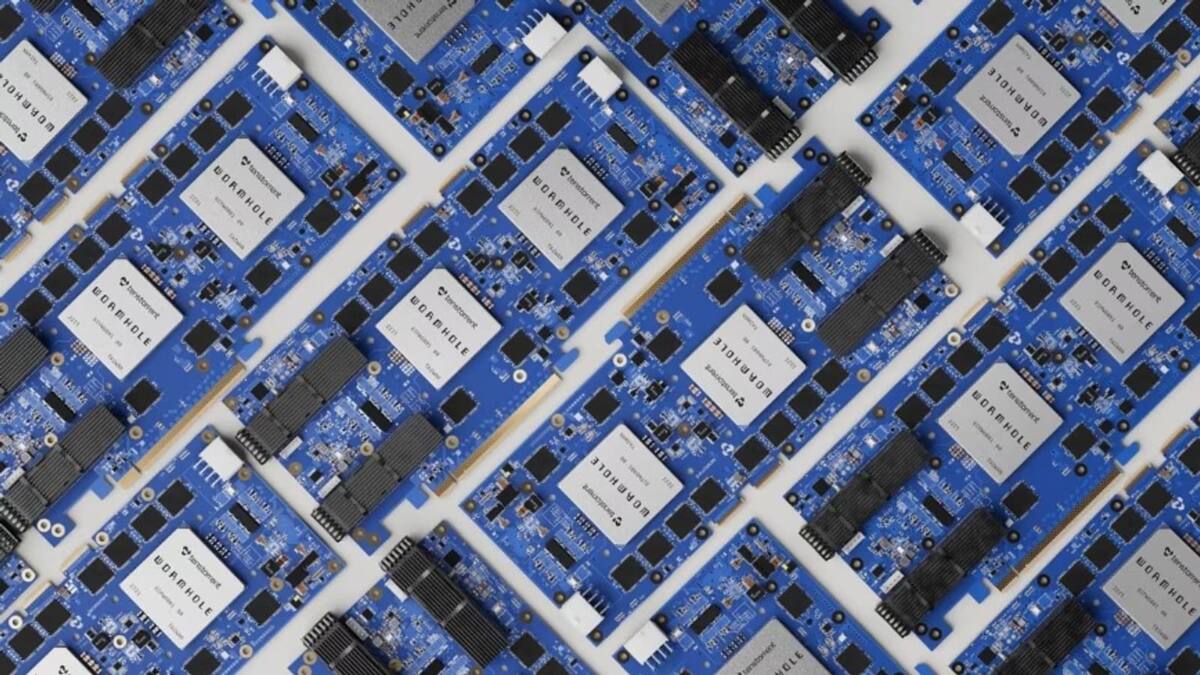
Intel and Qualcomm are reportedly testing the waters for a possible takeover of Tenstorrent, the AI chip startup that has become one of the cleaner bets on non-Nvidia hardware. The talks are still early, and that matters: even flirtations like this signal that big silicon players no longer want to sit out the race for alternative AI architectures.
Tenstorrent is attractive for reasons that go beyond hype. It already has about $150 million in customer contracts, a funding history that has climbed sharply in a short time, and a rare hybrid model that combines chip sales with IP licensing. In a market where everyone wants leverage against Nvidia, that combination is catnip.
Why Tenstorrent has buyers looking twice
The startup builds AI accelerators around open RISC-V architecture, using Ascalon processor cores and Tensix tensor cores. That gives it a cleaner independence story than companies tied to Arm, and it also gives potential buyers something harder to replicate than a single chip SKU: a development path.
Its appeal is also financial. Tenstorrent was discussing another funding round in November 2025 at a $3.2 billion pre-money valuation, up from a $2.6 billion Series D closed in December 2024. When strategic buyers show up after that kind of run-up, they are not shopping for a bargain.
- Potential valuation discussed in November 2025: $3.2 billion before investment
- Series D closed in December 2024: $693 million at a $2.6 billion valuation
- Known customer contracts: about $150 million
Intel and Qualcomm want an accelerator reset
For Intel, the logic is pretty blunt. Its Gaudi line did not meet market expectations, and buying Tenstorrent would give the company a ready-made alternative instead of another long internal slog. It would also hand Intel a more credible AI story at a time when the rest of the industry is treating in-house development like a luxury.
Qualcomm’s angle is even more interesting. The company dominates mobile SoCs and has long lived in Arm territory, but it barely plays in data centers. Tenstorrent could offer Qualcomm both licensable AI blocks and a server roadmap that does not depend on Arm, which is exactly the sort of escape hatch chipmakers like to buy before they need it.
Jim Keller is part of the premium
Tenstorrent is not just a pile of IP with a customer deck attached. CEO Jim Keller brings a resume that includes Apple A-series chips, Tesla autopilot silicon, AMD’s Zen architecture, and Intel engineering leadership. In other words, this is the sort of person acquirers pay for twice: once in technology, once in credibility.
That credibility matters because the AI hardware market is being repriced in real time. Nvidia has committed more than $40 billion in stock obligations to secure long-term GPU supply, Google’s TPU effort has already proven that custom silicon can scale, and names like Cerebras and Groq have kept attracting capital as investors hunt for the next viable alternative. Tenstorrent sits right in that current, which is why a buyer would likely pay for position as much as for product.
A sale, an investment, or a higher IPO price
Bloomberg says the talks are preliminary and do not yet amount to a deal, and the company has not said whether it would prefer a full acquisition, a strategic stake, or simply more cash on better terms. That ambiguity is standard in corporate finance, and it gives Tenstorrent leverage either way.
My bet: the startup will keep talking to both investors and strategic buyers while it stacks product announcements and customer wins. The moment those two streams start reinforcing each other, the question stops being whether Tenstorrent gets bought and becomes how expensive it gets for Intel or Qualcomm to wait.