
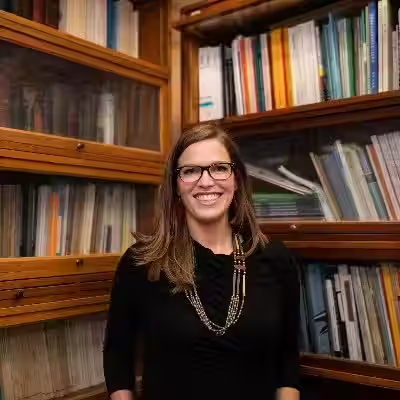

Sophia Amoruso says she has backed more than 45 startups, and her message to founders is refreshingly unromantic: investors are not buying slide decks, they are betting on people. In a recent Instagram reel, the Trust Fund founder and New York Times bestselling author laid out the founder traits she looks for before writing a check, and the list is basically a shortcut for ”show me you’ve done the work.”
That framing fits a broader investor shift that has been building for years. In a crowded startup market, ideas are easy to copy, but lived experience, domain knowledge, and relentless execution are harder to fake. Amoruso’s checklist is less about charisma than evidence.
Founder traits investors look for
Amoruso wants founders who have felt the pain point personally, not just researched it from a distance. If the problem was irritating enough to force action, that conviction tends to show up in the product, the pitch, and the stamina required to survive the early mess.
For founders without that scar tissue, the workaround is immersion: spend time with the people who do have it. Shadow customers, sit in their meetings, and see how the problem behaves in the wild. Investors can usually tell who studied the issue and who actually had to live it.
Industry knowledge beats generic ambition
The second filter is deep sector familiarity. Amoruso looks for people who have already worked inside the industry, talked to the same customers, and learned where the shortcuts are because they have already taken the bruises.
That is also why a lot of smart founders now pitch with a tight answer to a simple question: what do you know that others don’t? If the answer is fuzzy, the market probably is too, and that is a rough place to start a company.
- Have you personally felt the problem?
- Do you know the industry from the inside?
- Can you explain your unfair advantage in one sentence?
The founders who ask for help
Amoruso’s third trait is the one that will make some founders uncomfortable: she likes a bit of entitlement. Not the obnoxious kind. The kind that says, if an investor has influence, use it. Ask for introductions, advice, and whatever else can move the company forward.
That sounds blunt because it is. Venture capital is full of founders who act grateful for permission instead of demanding the support they were promised. Amoruso seems to prefer the opposite: people who know how to use every advantage available, and who are not shy about getting the most from the relationship.
The subtext is pretty clear. In startup land, politeness does not get you funded; momentum does. The founders who win are usually the ones who can prove they have the problem, know the space, and are bold enough to make the ask.