

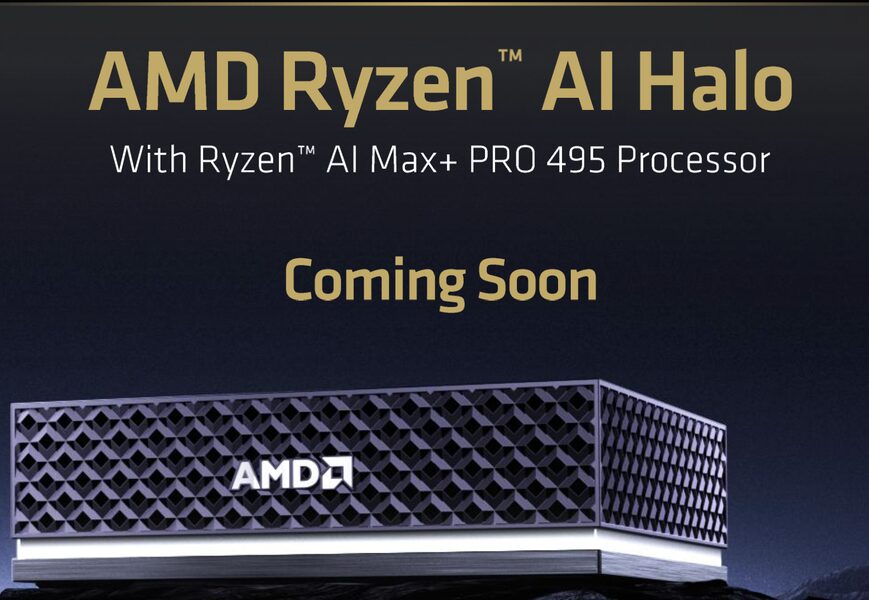
AMD has unveiled Ryzen AI Max 400 Pro, a new mobile processor lineup aimed squarely at workstations and local AI workloads. The headline number is hard to ignore: up to 192 GB of unified memory, with as much as 160 GB available to the integrated graphics, a spec that pushes these chips beyond ordinary laptop duty and into territory usually reserved for systems with discrete GPUs.
That kind of memory headroom matters because the market for on-device AI has moved fast. Nvidia still dominates serious GPU acceleration, but AMD is clearly trying to make integrated graphics look less like a compromise and more like a practical platform for large models, data work, and corporate deployments that want fewer moving parts.
Ryzen AI Max+ 495 Pro leads the lineup
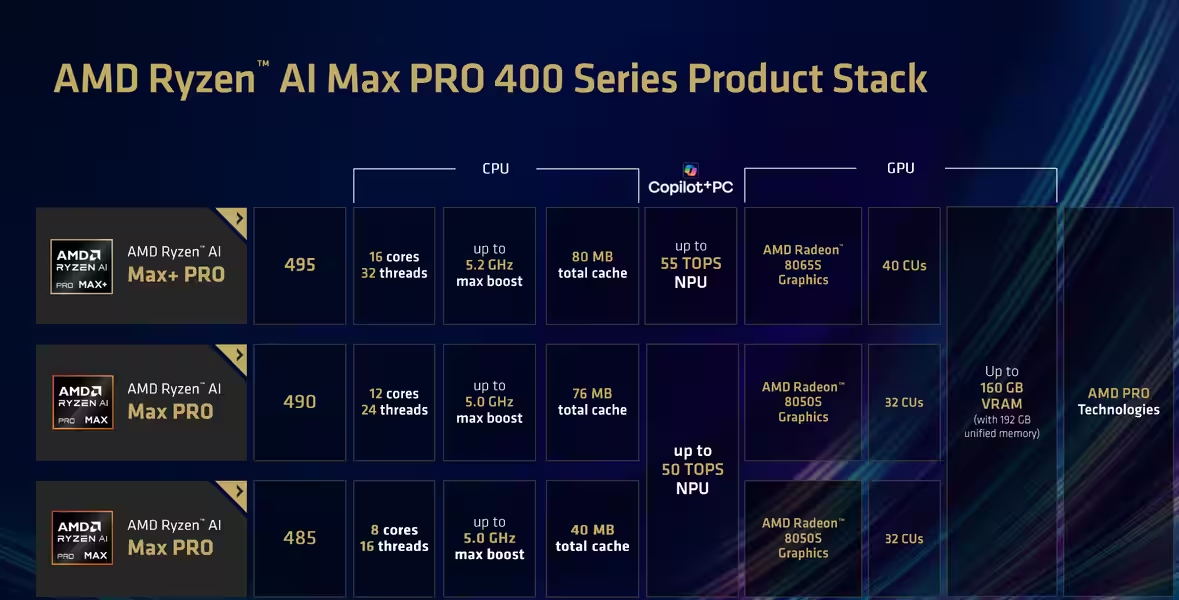
The series includes three processors. Ryzen AI Max+ 495 Pro tops the stack with 16 cores, 32 threads, boost speeds up to 5.2 GHz, 80 MB of cache, Radeon 8065S graphics with 40 compute units, and an NPU rated at up to 55 TOPS.
Ryzen AI Max 490 Pro offers 12 cores, 24 threads, boost speeds up to 5 GHz, 76 MB of cache, Radeon 8050S graphics with 32 compute units, and a 50 TOPS NPU. Ryzen AI Max 485 Pro keeps the same 5 GHz ceiling and 50 TOPS NPU, but drops to 8 cores, 16 threads, and 40 MB of cache. In other words: one platform, three tiers, and a very obvious attempt to sell the same underlying silicon into premium business machines at different price points.
Unified memory is the real headline
Architecturally, the chips are close to Strix Halo, but AMD is pitching this family for corporate buyers and professional users rather than enthusiasts chasing benchmark screenshots. The real hook is the ability to allocate massive chunks of system memory to the integrated GPU, which is exactly the sort of feature that makes local AI execution less painful and helps avoid the cost and complexity of a separate graphics card.
- Up to 192 GB unified memory
- Up to 160 GB for iGPU use
- 16-core top model with 55 TOPS NPU
- Built for workstations and AI-focused systems
AMD is saving the performance pitch for later
AMD has not said when these chips will arrive, and it is also not leaning on a dramatic performance claim this time. That silence suggests the company sees Ryzen AI Max 400 Pro as a bridge to a bigger refresh, likely before Medusa Halo shows up, while still giving OEMs something unusually capable to ship now.
The timing is telling. AMD also introduced EPYC 8005 yesterday and disclosed pricing for a powerful Ryzen AI Halo mini-PC built on Ryzen AI Max 400 Pro, which is a neat way to seed the market before the broader wave of laptops and compact workstations arrives. The open question is whether buyers will pay for all that memory and NPU silicon, or decide that a good old-fashioned discrete GPU still does the heavy lifting better.