

Google has rolled out Gemini 3.5, starting with Gemini 3.5 Flash, and it is already pushing the model into places most users will actually notice: the Gemini app and Google Search’s ”AI mode.” The company says the new version is faster, stronger on coding and agent-style tasks, and now serves as the default model worldwide for those products.
That matters because default settings shape behavior. Most people never switch models, so whichever system Google puts first gets the traffic, the feedback, and the bragging rights. Rivals can talk up benchmark scores all they want, but the model that ships at scale usually wins the argument in practice.
Gemini 3.5 Flash performance claims
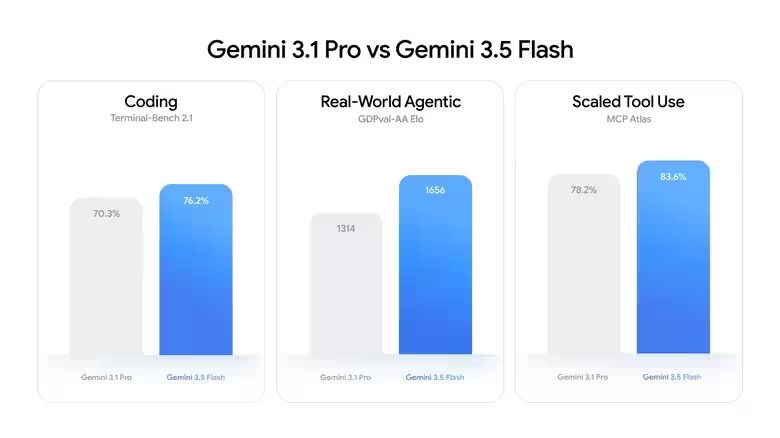
According to Google, Gemini 3.5 Flash is now able to handle programming and agent tasks at a level comparable to large flagship models. It is also positioned as a clear step up from the previous generation on both speed and raw output, with Google saying it can generate tokens four times faster than competing models.
The company points to several benchmark results to back that up:
- 76.2% in Terminal-Bench 2.1
- 83.6% in MCP Atlas
- 84.2% in CharXiv Reasoning
Those are the kinds of scores Google will want developers to remember, especially since OpenAI and Anthropic have spent months competing just as hard on ”agent” performance rather than plain chatbot polish.
Where Gemini 3.5 is available now
Google is making the model available across several channels at once. Regular users can access it through the Gemini app and Search, developers can use it through Google Antigravity, Google AI Studio, and Android Studio, and enterprise customers get access via Gemini Enterprise Agent Platform and Gemini Enterprise.
The rollout also reaches Gemini Spark, Google’s personal AI agent that is still in testing. That is a sensible move: if Google wants Gemini to feel like a platform rather than a demo, the same model has to power both consumer features and the tools developers build on top of them.
Safety controls and enterprise appeal
Google also says Gemini 3.5 Flash was built with stronger safeguards against cyber threats and risks involving chemical, biological, radiological, and nuclear materials. In theory, that should reduce harmful outputs without blocking safe requests, which is the tightrope every major AI company is now walking in public.
For businesses, that part may matter almost as much as the benchmarks. Banks and financial technology companies are already using the model to automate complex workflows, and they are unlikely to care much about model-name poetry if the system is fast, reliable, and less likely to hallucinate something expensive.
Google’s Gemini 3.5 Flash strategy
Gemini 3.5 Flash looks like Google’s attempt to do three things at once: beat rivals on performance, make Gemini feel ubiquitous, and convince enterprises that safety is not an afterthought. The next question is whether users notice the upgrade as a real-world speed boost or just another model number in a very crowded alphabet soup.