

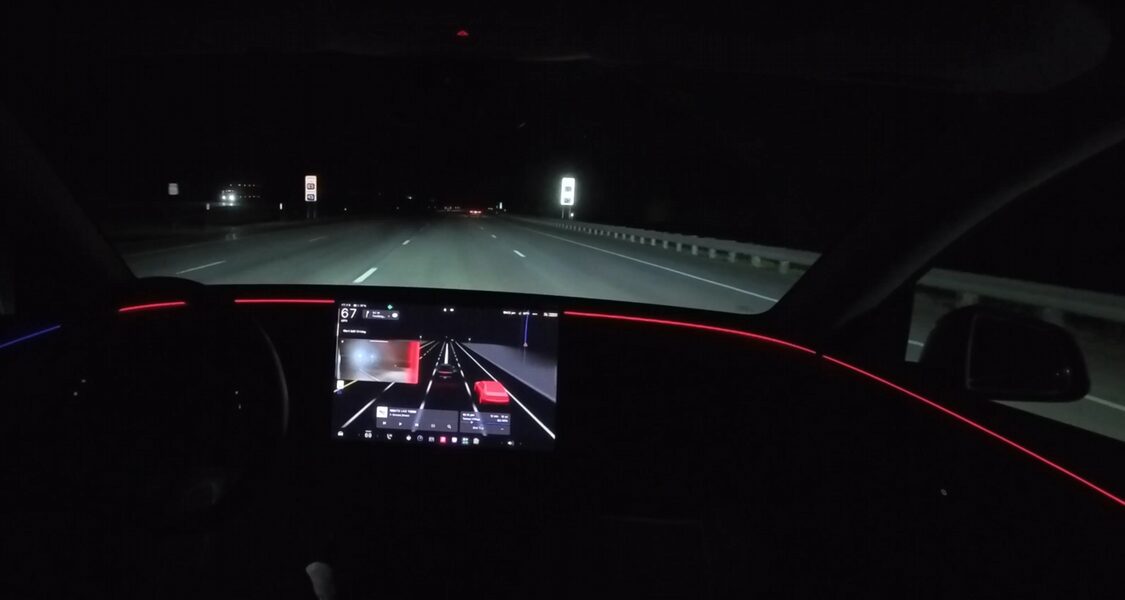
Tesla has pushed another software update into its cars, and this one is less about party tricks and more about not getting sideswiped. In the spring software update tied to FSD V14.3.3, the company added Blind Spot Warning Accent Lights, which turns part of the cabin lighting red on the side where a potential hazard sits in the blind spot when the turn signal is on.
The same trick can also trigger while the car is standing still if it detects something approaching. That makes the interior lighting part of the safety system rather than decoration, which is a neat idea if you like your alerts visible and mildly dramatic. Tesla has been leaning harder into this kind of software-defined behavior, while rivals keep trying to separate driver assistance from just flashing lights at you with varying success.
How Tesla’s cabin blind-spot warning works
The feature was shown by Sawyer Merritt, and it gives Tesla another layer of warning on top of the usual mirrors and dashboard alerts. Instead of burying the cue on a screen, the car uses the ambient lighting inside the cabin to flag danger on the relevant side.
That matters because drivers do not always stare at the instrument cluster with the focus of a hawk. A red light in the corner of your vision is harder to miss than a polite icon tucked into software menus, which is probably the point.
Actually Smart Summon gets a speed bump
FSD V14.3.3 also raises the top speed of Actually Smart Summon by 33% to 13 km/h. In plain English, the car should now make its way to you from a parking spot faster than before, assuming the situation is suitable and the system can handle it.
That improvement is small on paper, but it fits Tesla’s usual playbook: make the software feel a bit less sluggish, then let owners discover whether the extra speed is convenience or just a quicker way to worry about your bumper.
Tesla’s lighting strategy keeps getting more functional
There is a broader pattern here. Tesla keeps turning interior and exterior lights into software-controlled signals, which is cheaper to ship than adding new physical hardware and easier to expand in future updates. The upside is obvious: more alerts, less clutter. The downside is that every extra layer of cleverness also adds one more thing for owners to trust.
The next question is whether Tesla keeps building out these visual warnings across more models and more scenarios, or whether this ends up as one of those features people praise in demos and forget in daily driving. If the company keeps iterating at this pace, the cabin may become as much a warning surface as a place to sit.