

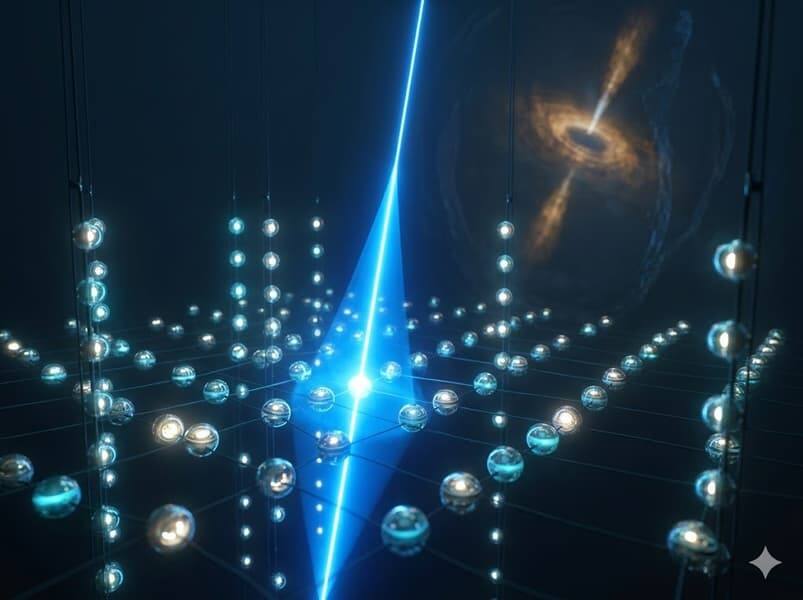
A detector buried in the Mediterranean has just seen something astrophysics has been chasing for years: a record-breaking-energy neutrino with energy so extreme it pushes far beyond the reach of any terrestrial accelerator. The KM3NeT collaboration says the event, KM3-230213A, was recorded by the ARCA telescope on 13 February 2023 at a depth of 3.5 kilometers off Sicily, and the particle’s reconstructed energy came out at about 120 petaelectronvolts, with the original neutrino possibly reaching 790 petaelectronvolts.
That is an absurd number by particle-physics standards. Even the Large Hadron Collider cannot get close, which is exactly why neutrinos are so valuable: they can carry information out of the most violent corners of the universe without being bent or absorbed the way charged cosmic rays are.
How the KM3NeT ARCA detector spotted the particle
ARCA works as a three-dimensional net of vertical lines with digital optical modules, each fitted with highly sensitive photomultipliers. When a neutrino hits water, it can produce a muon that races faster than light’s phase speed in that medium, triggering Cherenkov radiation – the flash that gives the game away.
The signal’s clean track made it possible to reconstruct the arrival direction with unusual precision, and the team says the event was not atmospheric in origin. In other words, this was not a local cosmic-ray nuisance dressed up as a headline; it looks like a visitor from deep space that passed straight through Earth.
A record seen with a half-built telescope
There is a wrinkle that makes the result even more striking: ARCA was still incomplete when it caught the event. Only 21 optical lines were active out of the full planned array of hundreds of detectors, so the telescope found a once-in-a-blue-moon particle while still under construction. That is the sort of accident instrument builders dream about and statisticians instantly distrust.
The skepticism is not baseless. IceCube in Antarctica and the Pierre Auger Observatory in Argentina had not previously seen neutrinos at this energy, and the discrepancy is estimated at about 2.5 sigma. That is interesting enough to chase, but not enough to hang a new cosmic model on.
- Reconstructed energy: about 120 petaelectronvolts
- Possible original neutrino energy: up to 790 petaelectronvolts
- Detection site: ARCA, 3.5 kilometers deep in the Mediterranean
- Array status at the time: 21 active optical lines
A blazar, a flare and a very short list of suspects
Researchers examined 17 possible sources in the sky region, including several blazars, the jet-powered cores of active galaxies. The leading candidate is PMN J0606-0724, which had a strong radio flare just five days before the neutrino was detected. One proposed explanation is dramatic even by cosmic standards: a red giant star may have been passing through the jet of a supermassive black hole, briefly creating the dense conditions needed to crank particles to extreme energies.
There are other possibilities too, from cosmogenic processes to the decay of dark-matter particles, but one event cannot settle the origin story of ultra-high-energy cosmic rays. What it does do is strengthen the case that active galactic nuclei with powerful jets can act as natural particle accelerators – and that the universe still has a few tricks more efficient than our biggest machines.
The next test is obvious: more events, more sky maps, and fewer cosmic one-offs. If KM3NeT keeps catching particles like this, the argument about where the universe builds its highest-energy beams is going to get a lot less theoretical, and a lot more crowded.