

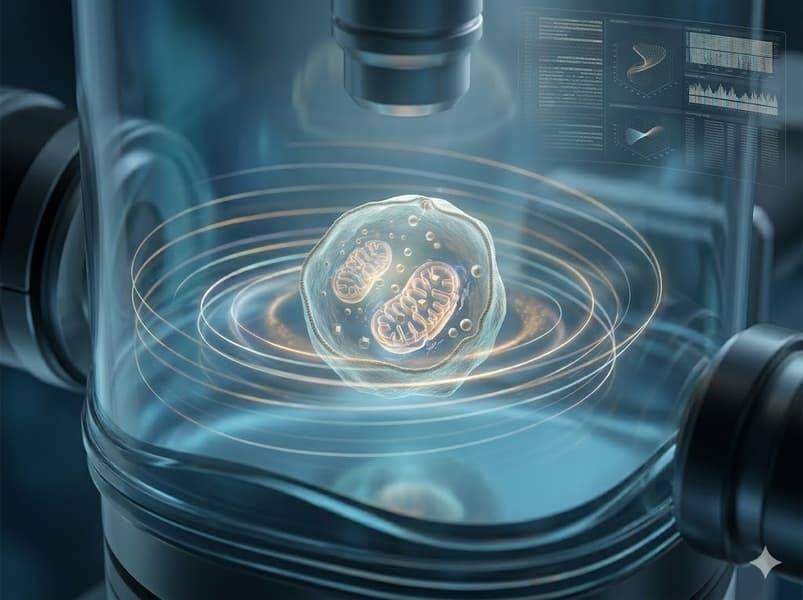
A team at the Karlsruhe Institute of Technology has found a way to rotate delicate microscopic samples without touching them, using a laser to create tiny fluid currents around the object. The result is a gentler method for 3D microscopy, where even a nudge can damage living cells or spoil the image.
The basic idea is sneaky in the best possible way: the laser does not grab the sample; it warms the surrounding liquid just enough to set up orderly microflows. Those flows then carry and turn the object, keeping it intact while the medium does the heavy lifting.
From flat movement to 3D rotation
Laser-induced flows are not new, but they were previously useful mainly for moving particles in one plane. KIT’s approach extends that control into three dimensions by generating a stable spiral current, so the sample can be turned from multiple angles instead of just slid around like dust on a table.
That matters because standard optical microscopes are great at sharp images in a single plane, but depth reconstruction usually demands multiple viewpoints and careful stitching afterward. If the sample cannot be oriented precisely, the final 3D model is good-looking but incomplete.
- Method: laser heating of liquid around the sample
- Effect: microflows create a gentle, controlled rotation
- Goal: better alignment for 3D imaging of living cells
Why this matters for 3D microscopy
In practice, the advance could let researchers ”unfold” biological structures in space and capture finer details of shape and internal organization. Moritz Kreysing of KIT says that better alignment reveals more detail, which is about as elegant and unglamorous as scientific progress gets.
The bigger prize may be outside microscopy. The same non-contact control could be useful for microrobotics and microfabrication, where physical tools are often too blunt for the job. If it scales, the real winner is anything too fragile to be touched and too valuable to be guessed at.
Potential uses in microrobotics and microfabrication
For now, the obvious test is whether the technique can be made reliable across different cell types and experimental setups. If it can, the old trade-off between precision and damage starts to look less like physics and more like a habit scientists are finally breaking.