

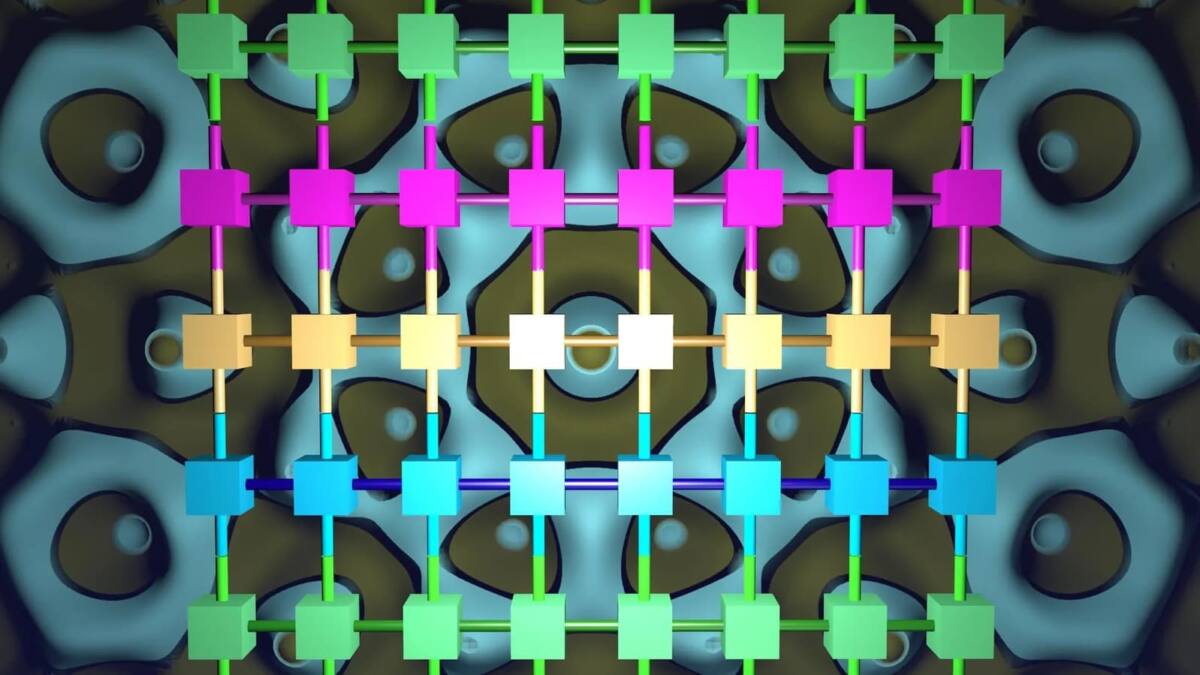
A team at Aalto University says it has built a quantum-inspired algorithm that can model some of the strangest quantum materials far faster than classical supercomputers can manage. The headline claim is not that a quantum computer did the work today, but that a different way of packaging the physics can turn a supposedly impossible problem into something tractable.
That matters because the materials in question are not ordinary crystals. Their properties can shift dramatically with tiny geometric changes, and the deeper researchers go into quasicrystals and supermoiré structures, the uglier the math gets. In practice, the number of variables can balloon to scales comparable with quadrillions of computation units, which is a polite way of saying brute force has been getting nowhere.
The new method, developed by researchers in Finland, uses tensor networks to encode the system instead of calculating every part of it directly. That is the same broad family of ideas that has made quantum simulation and condensed-matter theory more manageable in recent years: reduce the representation, keep the physics, and stop pretending a supercomputer enjoys suffering.
Quantum-inspired algorithm simulates a quasicrystal
According to the researchers, the quantum-inspired algorithm allowed them to simulate a quasicrystal with more than 268 million nodes. For classical methods, that scale had been close to off-limits. The result is still theoretical, but it shows how quickly the bottleneck changes once the problem is reformulated around compact quantum-style mathematics rather than raw enumeration.
- Method: quantum-inspired algorithm based on tensor networks
- Result: simulation of a quasicrystal with more than 268 million nodes
- Goal: model nonperiodic quantum structures that overwhelm classical supercomputers
Why topological quasicrystals are attracting attention
The real prize is not just speed. Topological quasicrystals are interesting because quantum excitations in them can behave very unevenly while still protecting conductivity from noise and outside interference. That combination has obvious appeal at a time when data centers and AI infrastructure are devouring electricity, and it hints at electronics that could eventually move current without the usual losses.
The familiar precedent here is graphene, where twisting layers at the right angle can produce a moiré pattern and even superconducting behavior. The new work pushes the same design logic into tougher territory: instead of asking whether exotic properties exist, it asks how far researchers can go in engineering them before the calculation itself collapses.
Quantum computers may become the lab bench
The researchers see this as part of a feedback loop. Better quantum materials help build better quantum computers, and better quantum computers help simulate better materials. That is a neat little circle, and also a race: whoever breaks out of the loop first will get the most useful hardware.
For now, the next test is obvious. If the same method can be implemented on real quantum hardware, including Finland’s quantum computing research infrastructure, then material design may become one of the first practical jobs for quantum computers rather than a demo for slide decks and grant proposals.