

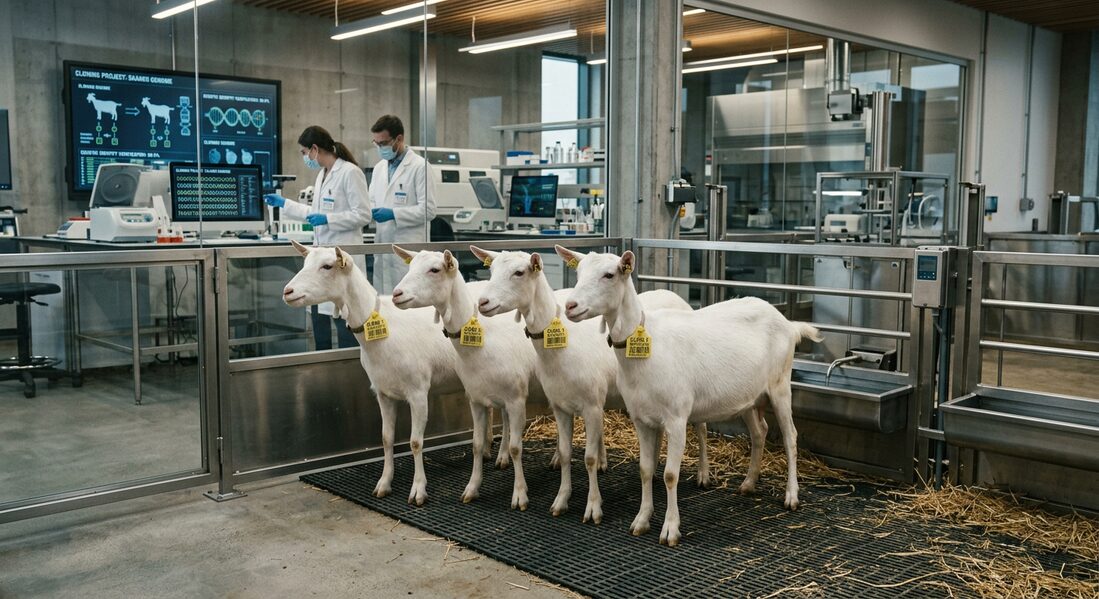
Chinese researchers say they have pulled off the country’s first successful series cloning of domestic animals, producing six pedigree dairy goats from elite breeding stock. The result is a tidy proof of concept for China goat cloning, a technique that could shorten breeding cycles by years, and it also hints at where livestock genetics is headed next: less patient waiting, more industrial precision.
Six cloned goats, split by sex
The breakthrough came from Northwest A&F University in Shaanxi province, where scientists worked with dairy goats and produced four males and two females. The cloning used pedigree animals as the starting material, which matters because the whole point is not just making another goat, but copying desirable genetics with far less guesswork than conventional breeding.
According to Xinhua, the key was accurate isolation of high-quality somatic cells followed by a tighter, more stable production process. That is the unglamorous part of biotech progress: the magic usually looks like process control, and the labs that get that part right tend to win more often than the ones that merely talk big.
Why livestock cloning is moving faster
Chinese scientists say the method could speed up the creation of productive herds. Traditional breeding can take 8 to 10 years to deliver the desired result, while cloning can compress that timeline dramatically. That promise is especially attractive in dairy and meat production, where even small gains in yield, disease resistance, or uniformity can scale quickly across a commercial herd.
China has spent years pushing animal biotechnology, and this result fits a broader pattern: turn experimental methods into repeatable production. Similar work elsewhere has often stayed limited to research or niche commercial use, partly because cloning is technically demanding and partly because the economics only make sense when the animals are genuinely valuable.
What the cloning result could change next
The big question is less whether this can be done again and more how widely it will be used. If the process keeps getting more reliable, breeders may lean on cloning to preserve top-performing genetics before using those animals in broader breeding programs. That would make cloning less a replacement for selection than a high-end shortcut around it.
For now, the headline number is simple: six cloned goats. The more interesting number is the one the industry wants to erase – 8 to 10 years – because shaving that down is where cloning stops being a science story and starts becoming a business model.