

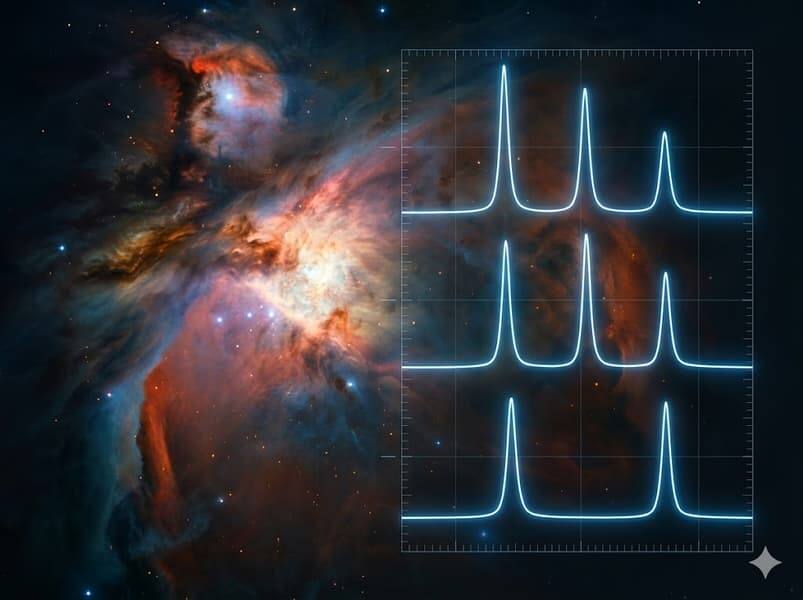
Astrophysicists have pulled off an unusual feat: they measured key carbon constants more precisely from space than lab instruments on the ground had managed for decades. Using the SOFIA stratospheric observatory, an international team finally pinned down all three spectral lines of a rare carbon isotope, closing a gap in physics that had been open since 1986.
The result matters because carbon is one of astronomy’s workhorse elements. Its ionized form is used to trace star formation, galaxy collisions, and vast clouds of gas, but the common isotope can turn opaque in the brightest regions and scramble the picture. The rarer isotope is cleaner, but until now its frequencies were partly based on theory rather than direct measurement. That is a long time for a fundamental reference to sit on guesswork.
How SOFIA measured carbon from the stratosphere
The team worked with SOFIA, the modified Boeing 747-based observatory that flies above most of Earth’s water vapor at more than 13 kilometers. That elevation matters: it gives the telescope a clearer shot at terahertz signals that are badly muffled from the ground. The German upGREAT receiver, built for extreme spectral resolution, was aimed at bright photodissociation regions in Orion, where the signal was strong enough to separate all three hyperfine lines for the first time.
The observation was not just a lucky look at the sky. The researchers filtered out instrumental noise and internal standing waves, then converted Doppler shifts into precise frequency intervals. They also checked the result with radiative-transfer modeling of the Orion Bar at 247 Kelvin, using the main carbon isotope as the reference point. In other words: the cosmos passed calibration and the lab got corrected.
Why the rare carbon isotope became the better ruler
Ground-based spectroscopy has been stuck for years on a simple problem: the ion is chemically reactive, hard to isolate, and maddeningly difficult to trap in a clean laboratory setup. The last direct Earth-based measurements were in 1986, and only one line was actually captured; the other two were extrapolated from theory. That makes the new space-based measurement more than a tidy update. It replaces a 40-year-old approximation with something observably real.
- Object measured: an ionized, rare carbon isotope
- What was fixed: all three spectral lines of its hyperfine structure
- Where it was done: SOFIA, above 13 kilometers in the stratosphere
- Reference environment: Orion’s photodissociation regions and the Orion Bar
How the new carbon standard could spread
The obvious winner here is astrophysics, which now gets a cleaner ruler for estimating gas density, temperature, and motion from spectral surveys. But the bigger story is methodological: when Earth-bound apparatus hits a wall, high-resolution astronomy can do metrology’s job for it. That is not a small correction to the textbooks; it is a reminder that the universe occasionally doubles as the best-controlled experiment available.
The team says the same calibration approach can be extended to other tricky atoms and molecules in interstellar space. If that happens, the next round of ”constants” may be settled not by increasingly elaborate vacuum chambers on Earth, but by looking outward and letting the sky do the measuring. That is an awkward headline for the lab, and a very good one for everyone else.