

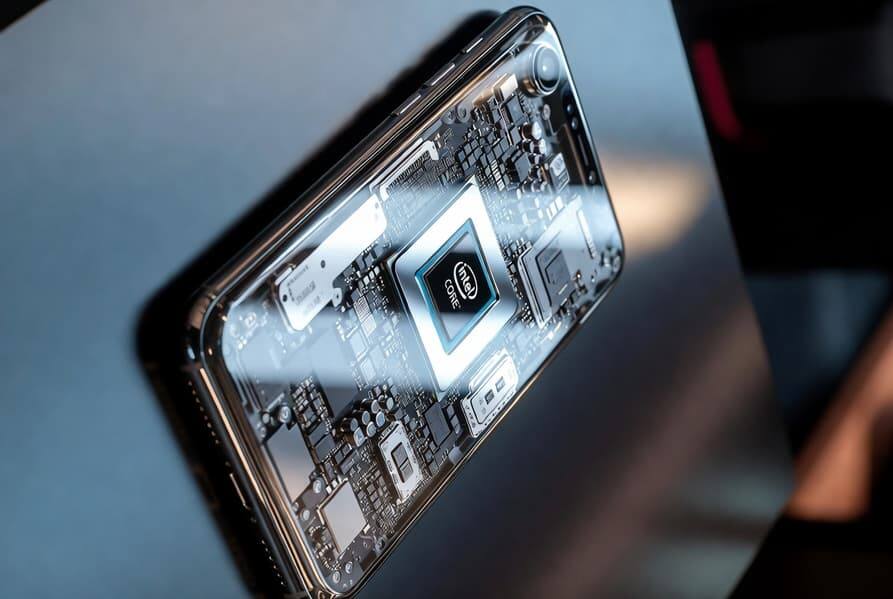
Intel has reportedly started manufacturing processors for Apple’s budget and older iPhone models, a move that hints at a slow but real reopening between the two rivals. Supply-chain analyst Ming-Chi Kuo says the first wave is small, with iPhone orders making up about 80% of the total, and Apple plans to keep the experiment modest before deciding whether Intel deserves a bigger role.
Intel’s iPhone role starts small
According to Kuo, Apple wants small-scale testing in 2026, then production growth in 2027, and further expansion in 2028. That timeline says a lot: Apple is not betting the farm on Intel, just poking it with a very expensive stick to see whether the silicon holds up. For a company that has relied heavily on TSMC for years, that is diversification with a side of caution.
The target Intel is aiming for in 2027 is a yield of 50% to 60% or higher. That is decent for a new manufacturing line, but it is still a long way from the kind of maturity Apple usually demands for high-volume consumer hardware. TSMC, meanwhile, is not looking over its shoulder too nervously: even if Intel’s first shipments go smoothly, TSMC is expected to keep more than 90% of the market.
Why Apple is testing Intel now
The timing is less surprising than it looks. Apple reportedly started talks with Intel long before TSMC ran into tighter advanced-node capacity, which suggests this was a contingency plan, not a panic move. Apple also appears to be reading the room: as foundry demand shifts toward AI chips, the company has every reason to secure backup manufacturing lanes before the good slots disappear.
There is another wrinkle here. Intel is trying to rebuild its foundry business while convincing customers it can deliver consistently at scale, and Apple is the hardest possible customer to impress. If Intel can turn older iPhone, iPad, and Mac parts into a reliable business, that would be a useful credibility win – even if TSMC still owns the premium end of the market.
Intel and Apple foundry timeline
- About 80% of the reported orders are for iPhone.
- Apple’s testing is expected in 2026.
- Production is expected to grow in 2027 and continue rising in 2028.
- Intel’s 2027 yield target is 50% to 60% or higher.
- TSMC is still expected to keep more than 90% of the market.
The interesting question is not whether Intel gets a few Apple orders. It is whether this becomes a genuine second source for Apple or just a controlled trial that never escapes the lab. If Intel misses the yield target, the answer writes itself; if it hits it, Apple may finally have a little more leverage over the world’s most important chipmaking bottleneck.